Dr. Stuart Wright, Senior Scientist, Gatan
Microscopy and Microanalysis (M&M) 2025 was held in Salt Lake City, UT. Our first TSL office was in Provo, UT but we moved a few years later to Draper, which is in the Salt Lake Valley. We stayed in the same location through the acquisitions of TSL by EDAX and AMETEK, then closed shortly after the merger of EDAX with Gatan. So having M&M in Salt Lake felt very familiar. But what made M&M memorable this year were some strong sessions on electron backscatter diffraction (EBSD) and related topics. The organizers of the quantitative diffraction symposium did a great job of organizing the sessions so that we had good interaction between EBSD and other related topics such as electron channeling contrast imaging (ECCI) and 4D STEM. I very much enjoyed my time at the Salt Palace Convention Center and came away with lots of good ideas.
My presentation at the meeting was nothing revolutionary. We’ve been doing spherical indexing of EBSD patterns [1] for a few years now and I continue to be amazed at how well it works. When Marc De Graef (who received two major awards at M&M) first introduced dictionary indexing I was skeptical. But the results he obtained convinced me quickly that dictionary indexing (and the subsequent development of spherical indexing) had some real merit on real-world samples. Now that spherical indexing is being used by customers, I essentially turned my M&M presentation into a FAQ. In case you missed it, here are a few highlights.
Master patterns
Master patterns are at the heart of spherical indexing. A master pattern for a new material can be a challenge to calculate. First, accurate crystallographic information must be obtained for the material. This can be obtained from several different sources. For some of the recent master patterns I have built for customers, I obtained a crystallographic information format (CIF) [2] from primarily three different sources. (1) Crystallography Open Database (https://www.crystallography.net/cod/index.php), (2) American Mineralogist Crystal Structure Database (https://rruff.geo.arizona.edu/AMS/amcsd.php), and (3) the International Centre for Diffraction Data’s PDF5+ powder diffraction database (https://www.icdd.com/pdf-5/). However, we have found from some materials that the phase to be investigated may not be well understood and it is often worth taking some time to examine the relevant phase diagram and potentially consider other possible phases. This is often a good first step before searching for a CIF in one of the crystallographic structure databases.
For a complex crystal structure, e.g., low symmetry with lots of atoms, the master pattern calculation can take several days even with a multi-threaded calculation on a good workstation. This can be a challenge when the phase is not well known, and master patterns are needed for several related phases through analysis of the phase diagram. You can imagine the frustration after calculating a master pattern at 20 kV accelerating voltage only to find out the EBSD patterns were obtained at 18 kV. There are a couple of potential shortcuts. (1) Construct an experimental master pattern. My colleague Will Lenthe gave a great presentation on this at M&M, which I won’t repeat here, but his work in that area is very promising. (2) Construct a kinematical master pattern which takes just a few minutes at the most. (3) Use the “off-kV” dynamical master pattern and (4) take a few shortcuts in calculating the dynamical master pattern.
Kinematical (2) and voltage variance (3)
Here are some results for (2) and (3).
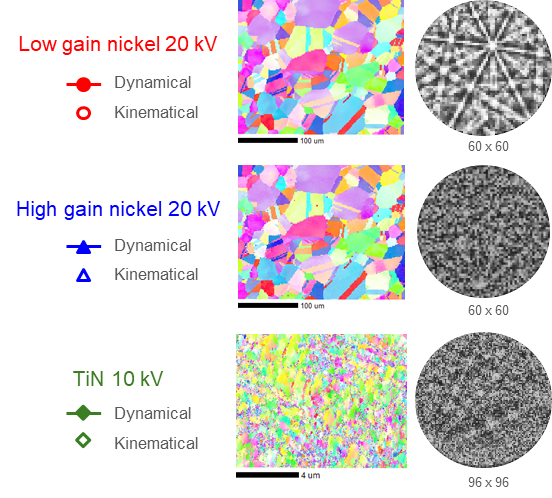
Figure 1. Summary of three sets of data used in the “off-kV” experiments. Nickel at 20 kV and two different gain levels and TiN at 10 kV.
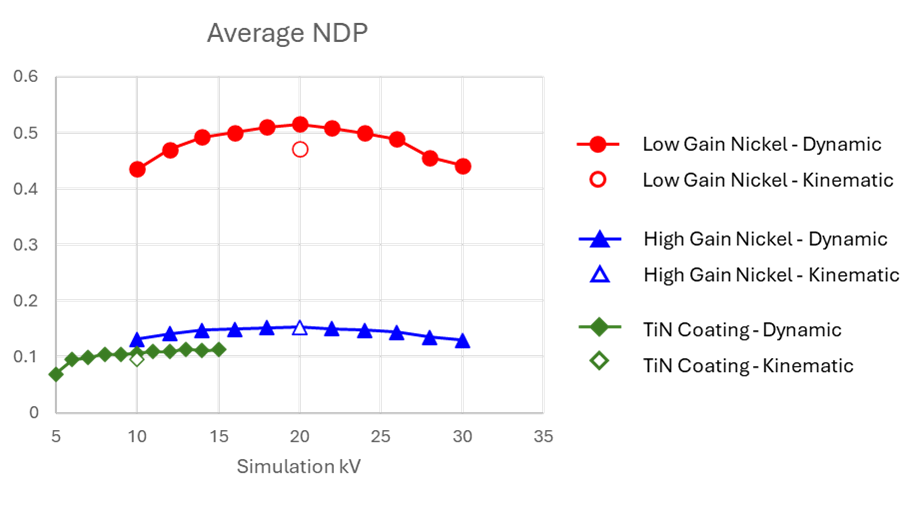
Figure 2. Normalized dot product from spherical indexing for varying degrees of “off-kV” master patterns, as well as kinematical master patterns for the three sets of data introduced in Figure 1.
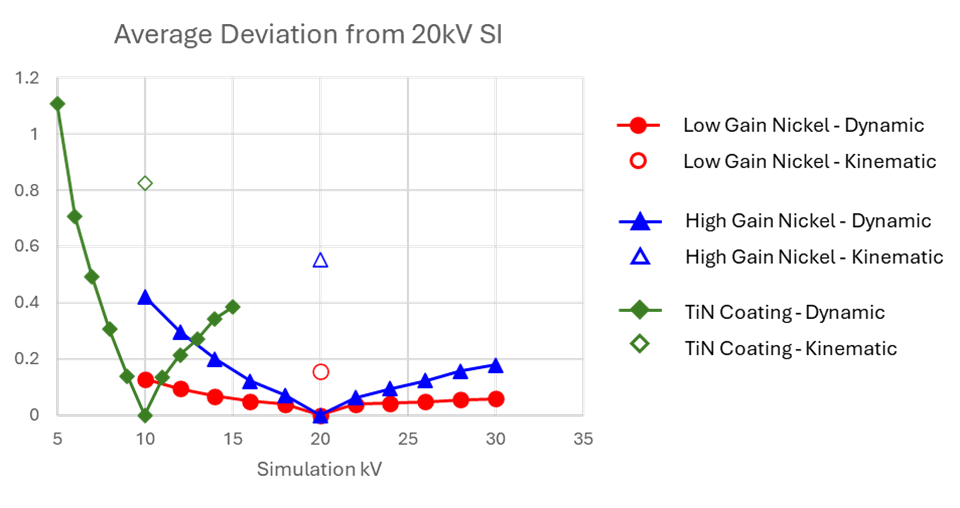
Figure 3. Average deviation in orientation from spherical indexing for varying degrees of “off-kV” master patterns, as well as kinematical master patterns for the three sets of data introduced in Figure 1. The reference orientations were obtained using a 20 kV dynamical master pattern for the nickel case and a 10 kV dynamical master pattern for TiN.
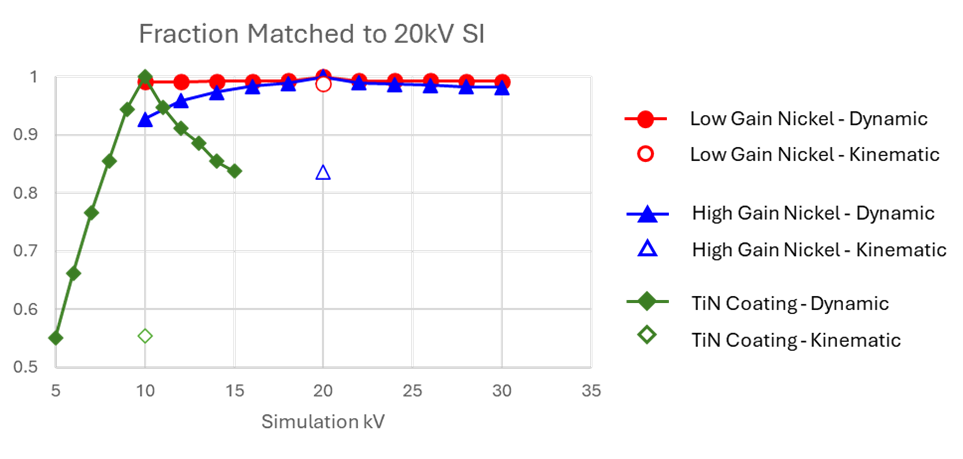
Figure 4. Fraction of orientations matched from spherical indexing for varying degrees of “off-kV” master patterns, as well as kinematical master patterns for the three sets of data introduced in Figure 1. The reference orientations were obtained using a 20 kV dynamical master pattern for the nickel case and a 10 kV dynamical master pattern for TiN.
These are busy figures so I will try to point out some interesting points:
- The normalized dot product, which is the confidence index (CI) for spherical indexing, does not vary much as the voltage varies away from the correct value. Using a kinematical master pattern instead of a dynamical master pattern shows only a slight degradation as you deviate from the correct voltage.
- The average deviation in orientation varies by only 0.1° for the high-quality Ni patterns over the ±5 kV range and 0.4° over the same range for the low-quality Ni patterns. However, the deviation is up to 1° over the same range for the lower kV patterns. The orientation deviation for the kinematical master patterns either exceeds or is nearly the same as the maximum deviation for the full kV range in all three cases.
- The fraction matched over the ±5 kV range for the 20 kV case remains strong over the full range. However, for the lower kV case, it drops off quickly and the matches for the kinematical cases are also very much reduced.
- My overall conclusion is that you can get away with kinematical master patterns when the patterns are good and at high voltages. In terms of the off-kV dynamical master patterns you can get away with ±5.0 kV at 20 kV and ±0.5 kV at 10 kV. However, if orientation precision is important, then you really need to stick with a dynamical master pattern at the correct voltage.
Dynamical shortcuts (4)
Are there some shortcuts to take to reduce the time required to construct a dynamical master pattern [3]? As an example, consider the chlorite mineral clinochlore.
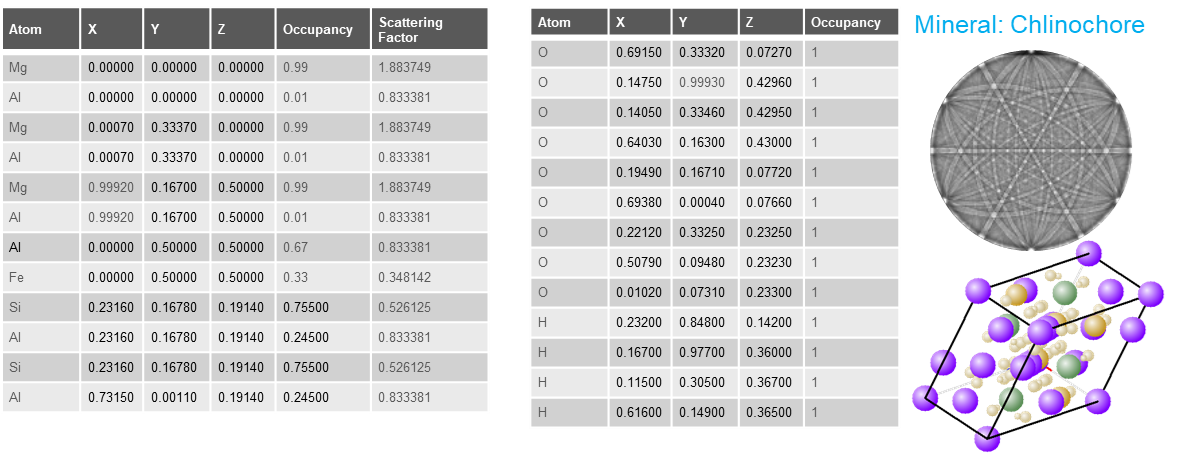
Figure 5. Atom positions and dynamical master pattern for clinochlore.
Do we really need all of the atoms? In this example, hydrogen is certainly not a strong scatter and thus its contribution should be minimal. If you look closely, you will see that several of the sites are shared. It may be possible to combine atoms at those sites. I have done this and simply use the atom with the majority occupancy at each site.
Here are the results. The times are not very accurate as I forgot to disable any other background processing during the calculations, but the trend is certainly worth noting.
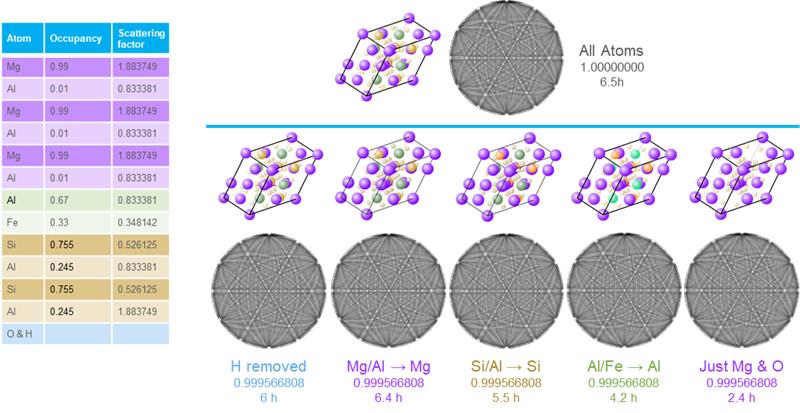
Figure 6. Master pattern comparison (normalized dot patterns over the full sphere) after removing H and merging shared atomic sites in clinochlore.
I originally tried removing oxygen thinking it wouldn’t be much of a scatterer, but it is important. As you can see in Figure 7, the master pattern changes considerably. That is a lessor in this exercise, some atoms are critical in terms of the role they can play in maintaining the crystallographic symmetry.
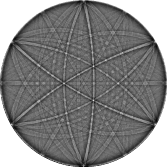
Figure 7. Comparison for the full clinochlore dynamical master pattern and the master pattern with oxygen removed.
We have implemented the capability to automatically filter out weak scatters and automatically merge shared atomic sites into single atom sites with weighted hybrid scattering factors in our development version of the EDAX OIM Analysis™ software. You will see it in an upcoming release.
Pattern size
Indexing success rates
What impact does the experimental pattern size matter for the different indexing methodologies? My short answer is that it varies. This question has been around for quite a while and we have addressed it for Hough-based and dictionary indexing in two separate publications [4, 5]. Figure 8 shows the addition of spherical indexing to these results. My conclusion is that the limit for dictionary indexing is remarkably small – 15 x 15-pixel patterns still give reasonable results; whereas, for Hough and spherical indexing, the limit is larger – approximately 50 x 50-pixel patterns.
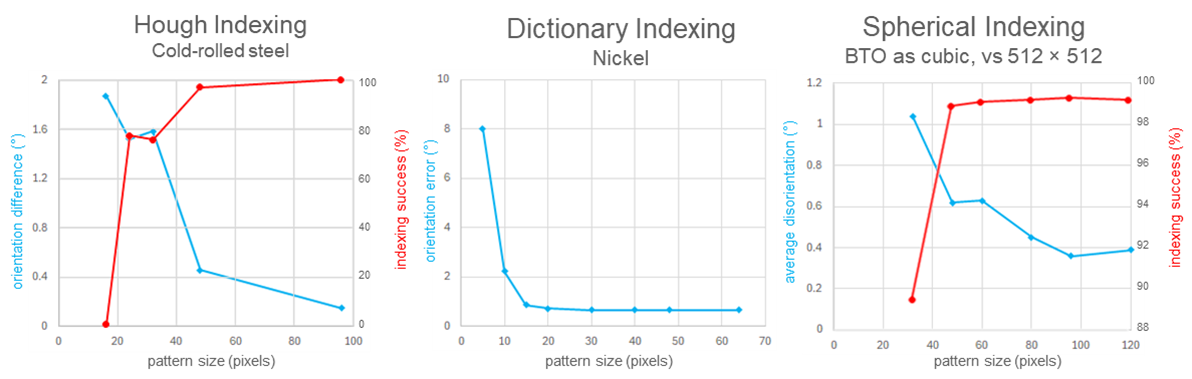
Figure 8. Effect of pattern size on orientation precision and indexing success rate for Hough, dictionary, and spherical indexing.
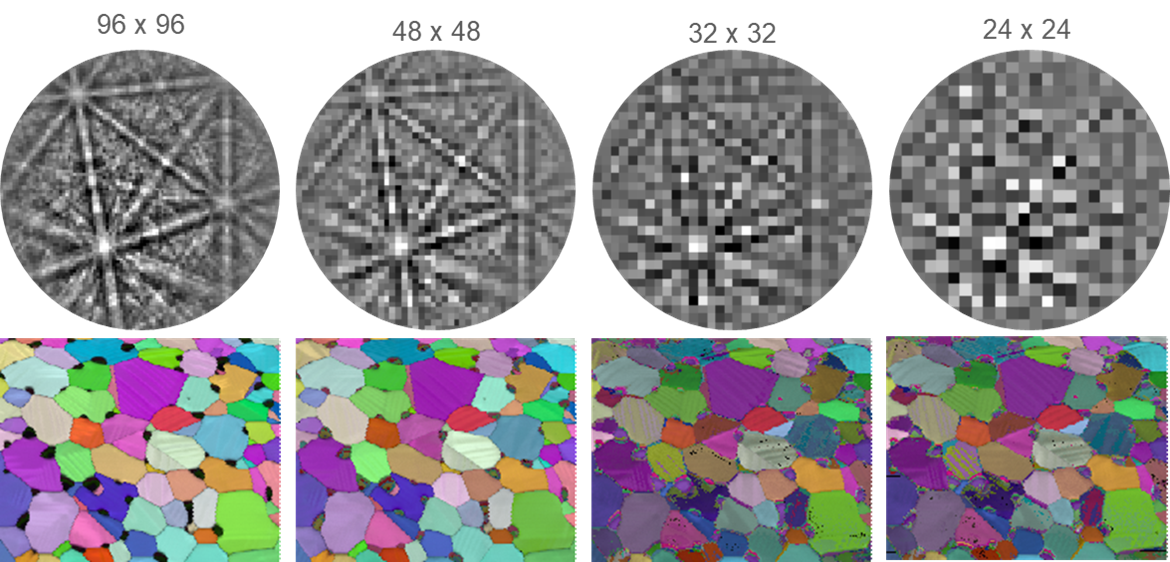
Figure 9. Orientation maps (overlaid on confidence index) obtained from BTO (indexed as cubic) using spherical indexing at different pattern sizes.
Orientation refinement
Pattern size also plays a role in orientation refinement. Orientation refinement is essentially a localized dictionary fit to the pattern. However, instead of using localized dictionaries we use a non-linear optimization approach [6]. The initial approximation of the orientation can come from Hough, dictionary, or spherical indexing. A bounded non-linear optimization is used to converge the best fit of a simulated pattern to the experimental pattern leading to excellent orientation precision results. The effects of pattern size and noise on the achievable precision (based on a 1 x 1 mm scan of a silicon single crystal) are shown in Figure 10.
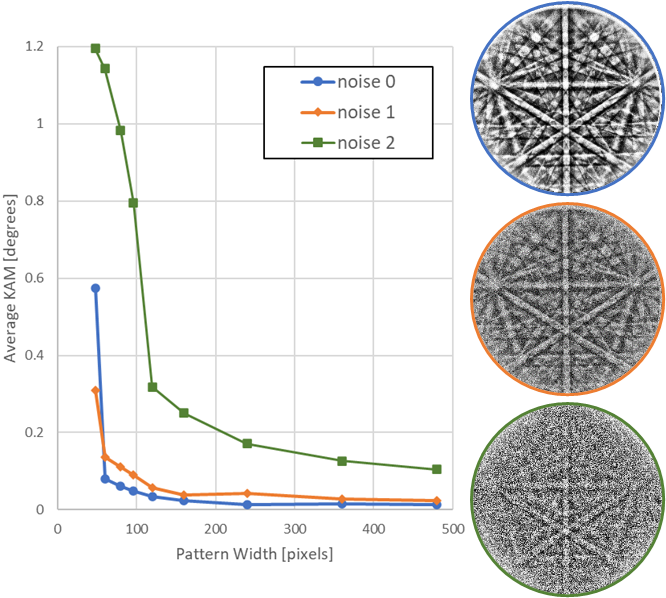
Figure 10. Orientation precision results for refinement on patterns from a silicon single crystal with three levels of noise added to the patterns.
These results suggest that only marginal improvement in orientation precision is obtained for pattern sizes beyond 150 x 150 pixels. However, for noisy patterns the larger pattern size does make a difference.
Bandwidth vs. refinement
Another question that has come up is which bandwidth to choose for spherical calculations. Within the EBSD group at Gatan, we typically use relatively small bandwidths – 63 or 127 primarily selected based on speed. A few customers have asked, “Why not use 255?”. Using the maximum value in the software of 255 will lead to better orientation precision. However, there are two things to consider. Larger bandwidths can occasionally improve the indexing success rate but are always slower. If the reason for selecting a high bandwidth is to improve orientation precision, resolving pseudo-symmetry, or overcoming phase differentiation challenges, then we have consistently found that orientation refinement provides a better (and considerably faster) solution. Figure 11 shows results on a silicon single crystal for different approaches to improving orientation precision.
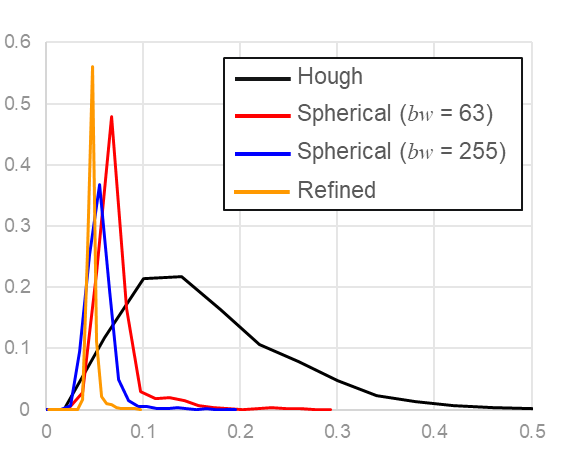
Figure 11. Orientation precision results for high bandwidth spherical indexing, orientation refinement vs. Hough-based indexing (nearest neighbor kernel average misorientation (KAM)).
The refinement approach produces an indexing rate of 4,280 patterns per second (Laptop with a T1000 GPU). Spherical indexing with a low-resolution bandwidth of 63 coupled with orientation refinement has an indexing rate of ~1,700 patterns per second, whereas spherical indexing with a high-resolution bandwidth of 255 is 50 points per second. So, it is better to index at a lower bandwidth and then do refinement than use a large bandwidth both in terms of fidelity, as well as speed in most cases.
Conclusion
I hope you made it to Salt Lake City for M&M. But if you missed it, I hope this summary of my presentation answers some of the questions that might have arisen on spherical indexing.
References
[1] Lenthe, W., Singh, S. & De Graef M. 2019. A spherical harmonic transform approach to the indexing of electron back-scattered diffraction patterns. Ultramicroscopy, 207, 112841. https://doi.org/10.1016/j.ultramic.2019.112841
[2] Hall, S.R., Allen, F.H. and Brown, I.D., 1991. The crystallographic information file (CIF): a new standard archive file for crystallography. Foundations of Crystallography, 47(6), pp.655-685.
[3] Callahan, P. G. & De Graef, M. 2013. Dynamical electron backscatter diffraction patterns. Part I: Pattern simulations. Microscopy and Microanalysis, 19, 1255-1265. https://doi.org/10.1017/S1431927613001840
[4] Hough: Wright, S. & Nowell, M. 2008. High-Speed EBSD. Advanced Materials and Processes, 166(2), 29-31.
[5] Dictionary: Ram, F., Singh, S., Wright, S. I. & De Graef, M. 2017. Error Analysis of Crystal Orientations Obtained by the Dictionary Approach to EBSD Indexing. Ultramicroscopy, 181, 17-26. https://doi.org/10.1016/j.ultramic.2017.04.016