Benefits
- Improve the accuracy of your results by resolving EDS peak overlaps with up to 15x better energy resolution than EDS alone
- Reliably detect minor and trace elements with improved spectral resolution and peak-to-background ratios (P/B)
- Supply results up to 8x faster than other systems by collecting more x-rays using the EDAX Lambda WDS spectrometers
- Provide precise quantitative results using a proven analytical algorithm
- Correlate with other techniques to perform the most comprehensive analysis available
- Avoid operator error and analysis pitfalls by capturing EDS and WDS data simultaneously
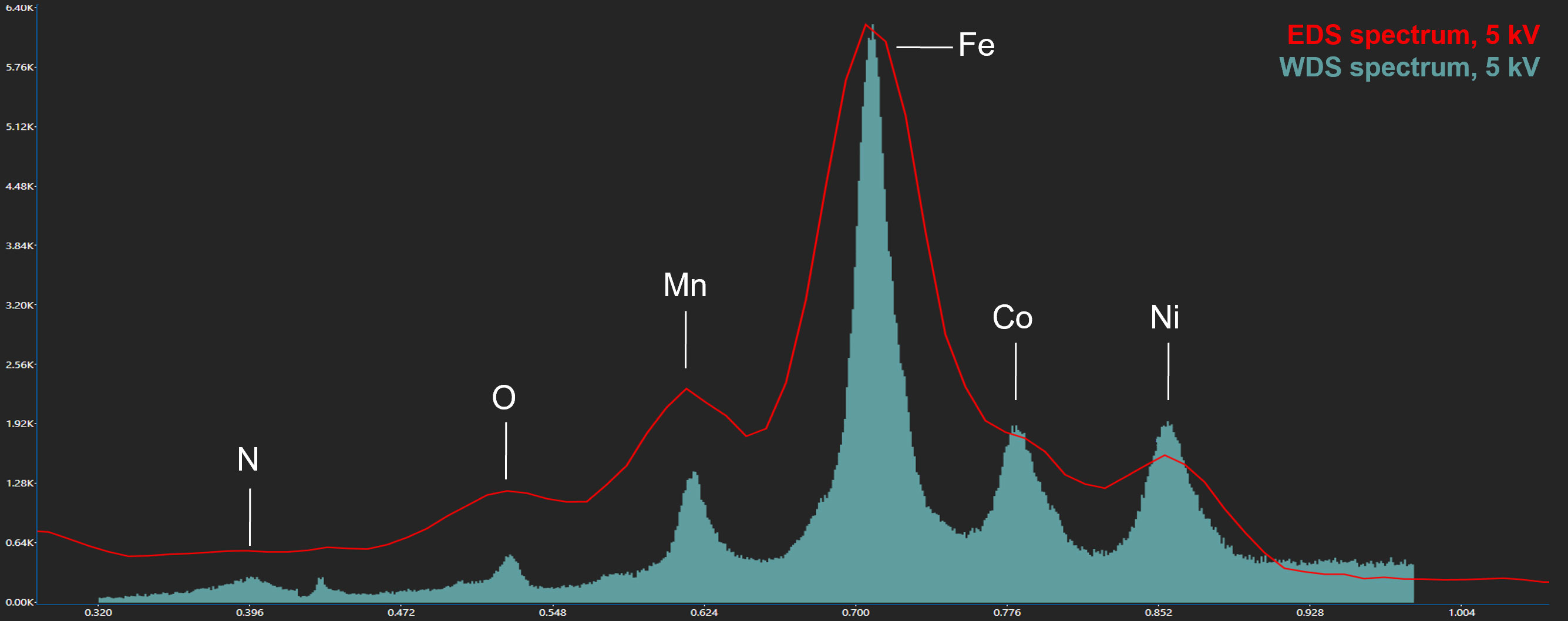
Figure 1. An overlay of EDS (red outline) and WDS (cyan color) spectra of an alloy sample at 5 kV.
The Lambda WDS spectrometers can provide up to 15x better energy resolution than EDS detectors. This allows you to address shortcomings of EDS analysis and resolve EDS peak overlaps; WDS also improves the minimum detection limit by 10x. The Lambda spectrometers can detect minor and trace elements with improved P/B.
Enhance the analysis of complex materials with improved sensitivity to surface information by resolving the transition metal L lines with 10x increased depth resolution. Neptune extends the analytical capability of all SEMs with higher contrast maps for hard-to-see elements, detecting trace elements and elements that are difficult to observe with EDS alone and providing up to 8x higher P/B* than Rowland’s Circle spectrometers.
Neptune removes the need for ‘expert only’ tools and training. It allows users to bring electron probe microanalyzer-like capability in-house. Users can collect results immediately avoiding costly delays in analysis, reducing the need to purchase expensive or highly specialized tools.
*Based on P/B of B Ka using Lambda Plus WDS system; Lambda Super provides 2.5x improvement

Figure 2. EDS (top) and WDS (bottom) maps of the Si-W-Ta sample. The WDS maps resolve the artifacts due to Ta M, Si K, and W M peak overlaps in the EDS maps.
Resources
Product bulletins/Datasheets
Application notes