Benefits
- Improve the accuracy of your results by collecting compositional and crystallographic orientation data in one easy-to-use package
- Expand your analytical capabilities to include the widest range of materials, including complex samples
- Get results in minutes rather than hours or days
- Correlate with other techniques to perform the most comprehensive analysis available
- Avoid operator error and analysis pitfalls by streamlining analysis through simultaneous data collection

Figure 1. a and b) EBSD orientation maps were collected at >3,000 indexed points per second using a Velocity Plus EBSD detector. c) Elemental map by EDS was collected simultaneously with EBSD data using an Octane Elect Super detector. Colorized to display copper (red), iron (green), and nickel (blue). d and f) Phase maps were determined from data. Colorized to display copper (top – blue, bottom – orange) and Kovar (top – yellow, bottom – green).
Trident is built upon the principle that advancements in modern materials require the most detailed understanding of composition and crystallography to uncover the structure-function relationship. Whether revealing the segregation of trace elements to grain boundaries in solar cell technologies or characterizing inclusions within steel, determining the crystal structure and composition down to trace element levels requires more than one technique. Trident combines EDS, WDS, and EBSD detectors in one simple-to-use software platform, providing the most complete understanding of your samples.
Crystallographic information is captured using the latest EDAX EBSD systems, which, when combined with compositional information from EDS using the Chi-Scan™ feature, can improve the success of indexing EBSD patterns and reduce acquisition and analysis times by more than 10x. Extending the characterization to reveal elements present at trace levels (can be less than 0.1 wt. %) using WDS provides the most detailed knowledge of your sample, allowing you to make deep insights.
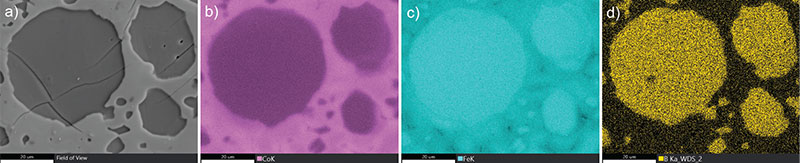
Figure 2. a) An SEM image of a steel sample. The b) cobalt and c) iron elemental maps using EDS analysis. d) The boron elemental map using WDS analysis.
Resources
Product bulletins/datasheets