Introduction
In a demonstration of the Orbis micro-XRF system, a customer mentioned that they were having trouble measuring iodine in table salt with their current XRF system. This seems like a straightforward exercise, but upon further investigation, it was not.
The iodization of salt in the United States began about a century ago. Iodine is an important micro-nutrient for thyroid gland health. Certain portions of the American population had diets deficient in iodine and the iodization of table salt was chosen as a method to increase the level of iodine in the average American diet. The salt iodization process was inexpensive; salt does not spoil and estimates of table salt consumption were available.
Experiment
A few weeks prior to the customer demo, iodized table salt was purchased from a local grocery store. The ingredients list showed iodine in the form of potassium iodide at about 45 ppm iodine. This was consistent with what can be found via web searches. A pile of salt grains was pressed onto a piece of carbon tape and measured with the Orbis system using a 2 mm spot size. The system was equipped to measure down to 30 μm spot sizes, small enough for individual grains, but 2 mm was chosen to avoid any potential issues with grain to grain variations. The presence of iodine was confirmed via the I(L) series and quantified using the I(L⍺) line at 3.937 keV (Figure 1).
 Figure 1. (a) Salt spectrum with peak deconvolution not including I(L) series. (b) Salt spectrum as in (a) with peak deconvolution including I(L) series.
A few weeks later during the customer demonstration, a variety of customer supplied samples were measured and a request to measure table salt was made by the customer at the end of the session. The same table salt sample was measured again in the Orbis, only to discover that the iodine signal was no longer present (Figure 2). Peak fitting and quantification results showed no iodine at all. Given that solid I2 is known to undergo sublimation, it was speculated that the iodization level in the salt was somehow not stable. The customer confirmed that in previous attempts, he had measured table salt from shakers in the company cafeteria where the residence time of the salt in the shaker was unknown.
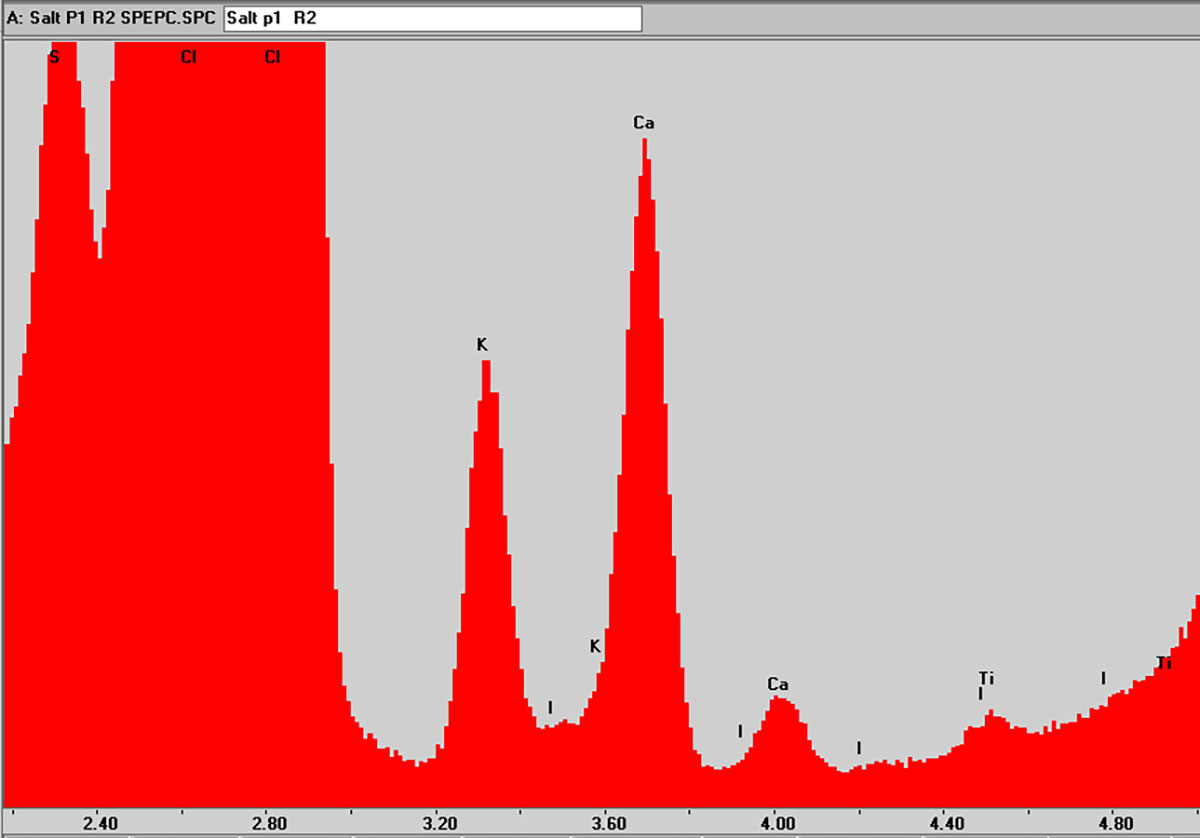 Figure 2. The same salts as Figure 1 measured a few weeks later on the Orbis without the presence of iodine.
Further web searches indicated that indeed, the iodization level of salt has a certain shelf life depending on many factors including temperature, humidity, impurities in the salt, the chemical form of the iodine bearing additives, and product packaging. For example, in the form of potassium iodide, the iodide is oxidized by contact with oxygen and atmospheric moisture and the resulting iodine then undergoes sublimation. In various regions of the world, iodized table salt is formulated to improve its shelf life based on the characteristics of the table salt and the general environment, i.e. desert, tropical, etc.
In this case, the iodine level had dropped to near or below detectable limits after about three weeks of being left out in atmospheric conditions. The grains of salt ranged in size from about 100 to 500 μm in characteristic dimensions, which posed a basic question.
To what characteristic depth was XRF measuring? Was there possibly any iodine left in the largest crystals? This depth can be estimated based on the emission range of the fluorescent signal energy as the exciting X-ray energy always has to be greater than the measured signal. (The physics are a bit different for electron excitation, where the answer is determined by electron penetration depth into the sample.)
XRF measurement depth can be estimated from the Beer-Lambert equation for the absorption and transmission of light:
 Equation 1.
Where:
- Io = incident intensity
- I = transmitted intensity
- μ = mass absorption coefficient (cm2/gm)
- 𝜌 = density (gm/cm3)
- x = path length (cm)
The mass absorption coefficient (MAC) describes how readily the I(L⍺) signal line at 3.937 keV will be absorbed by the NaCl matrix. The total MAC of a matrix as a function of fluoresced photon energy can be described as follows:
 Equation 2.
Where:
- μmatrix(E) = matrix MAC for analyte photon with E energy
- ωi = weight fraction of individual matrix element “i”
- μi(E) = MAC for element “i” for analyte photon with E energy
For NaCl, there are two MACs describing how Na and Cl each absorb the 3.937 keV photon. The easiest way to get the full matrix MAC is to back calculate it from the Beer-Lambert equation using any web-based calculator describing X-ray absorption/transmission characteristics modeling the signal photon traversing the sample matrix to the detector, such as: https://henke.lbl.gov/optical_constants/filter2.html.
By inputting the sample matrix formula (including trace elements if desired), and an arbitrary matrix path length, one can get the calculated result for I/Io and then rearrange Equation (1) to solve for the NaCl matrix MAC by inputting the previously used path length and the known density of table salt. The result is: μNaCl(3.937 keV) ~ 540 cm2/g. Rearranging Equation (1), one can solve for the signal path length through the sample traversed by the fluoresced photon to the detector as a function of I/Io.:
 Equation 3.
The XRF Emission Depth, d, would typically be defined as normal to the sample surface and should also consider the take-off angle (TOA) of the detector defined from the sample surface as shown in Equation (4).
 Equation 4.
Table 1 shows the XRF Emission Depth as a function I/Io with a nominal detector TOA of 50°.
| I/Io [%] |
|
Path Length, x [µm] |
|
Emission Depth, d [µm] |
| 10 |
|
20 |
|
15 |
| 1 |
|
39 |
|
30 |
| 0.1 |
|
59 |
|
45 |
| Table 1. XRF Emission Depth as a function of the signal transmission ratio, I/Io. |
The definition of the characteristic XRF path length and emission depth is somewhat arbitrary, as it depends on how one defines the signal transmission ratio, I/Io. Typically, the characteristic path length has been defined as the length over which 99% of the signal has been absorbed. Hence:
 Equation 5.
It is interesting to note from Table 1, that at 50% of the critical emission depth, the XRF signal is undergoing 90% absorption
Conclusion
Coming back to the original analysis, it is possible that iodine was still present at the core of the larger 500 μm grains of salt. Further analyses could be done on cross-sectioned grains or pulverized grains to make that determination. It would be possible to measure cross-sectioned grains of NaCl using the 30 μm spot size on the Orbis to study how readily iodine is lost as a function of depth into the NaCl grain, but that is a study for another day.