Introduction
Energy dispersive x-ray spectroscopy (EDS) can be an essential tool to help understand the elemental composition of samples. EDS mapping results can be tricky in some situations because only the distributions of those major elements are shown. For those inclusions or trace elements (only occupy a small proportion of pixels and are of <1 wt%), the clear and precise characterizations can be difficult due to the relatively few x-ray counts they can produce. Moreover, most inclusions and trace elements are unknown before EDS measurements, and even the most experienced microscopists are not willing to perform a substantial EDS data acquisition process. Thus, it is very challenging to decipher those trace unknowns in a reasonable EDS experiment time.
Results and Discussion
We recently received a batch of Mg alloy EBSD samples for an EDAX EBSD product demonstration. Interestingly, one of these sample’s surface contained a lot of particulate matter (Figure 1). Out of curiosity, we examined the polished surface and surficial matter via EDS point analysis using the EDAX Octane Elite Super detector. Although those EDS qualitative and quantitative results looked the same, having similar Mg, Al, C, and O contents for both surface and matter, we noticed from the EDS spectrum shape that there were trace elements in this sample.

Figure 1. SEM image for the Mg alloy sample.
Figure 2 shows the exemplary spectrum from this sample. We customized the spectrum range manually to exhibit better-detailed features at ~1.3 keV. Compared with the deconvolution curve (cyan), the spectrum (red) showed more detailed structures that were related to unidentified trace elements. In Figure 2b, Eu M and Zn L lines were added, demonstrating a better fit between the deconvolution curve and experimental spectrum.
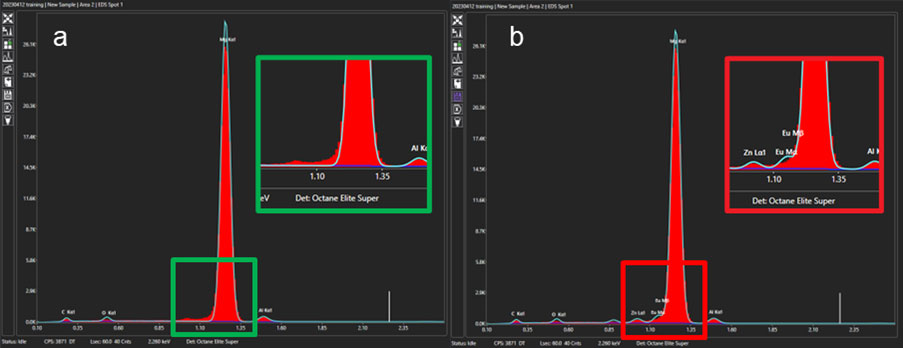
Figure 2. Full frame spectrum for the Mg alloy sample: a) auto Element ID and b) manually added trace elements.
Using the eZAF algorithm, we can get the quantification results from the APEX software, showing that Eu was <1 wt% in this Mg alloy. Conventionally, it is very easy to omit trace elements with EDS mapping, due to its cumulative spectrum (summed over all points) method. In APEX, we have a unique feature, Maximum Pixel Spectrum. This feature is capable of solving trace elements or inclusion mapping problems. When the Maximum Pixel button (Figure 3) is pressed during EDS mapping acquisition, APEX starts displaying the highest number of counts for each energy channel in any spectrum, and reveals the presence of trace elements, in this case, the rare earth element Eu.
Figure 3. Max Pixel button in the Mapping ribbon in the EDAX APEX software.
In this experiment, we used 15 kV and a moderate beam current to produce ~130 k output counts per second (ocps) and then started EDS mapping acquisition. After initiating Maximum Pixel Spectrum, within 10 minutes, the detailed Eu (using Eu L series) locations were revealed efficiently and accurately (Figure 4f).
Surprisingly, Eu's distribution strongly correlated with Al (Figure 5). Those two elements may have a synergistic effect on this Mg alloy to enhance its mechanical properties. At this moment, we contacted this customer and told him we found Eu present via EDS mapping. He was shocked to hear this at first, and then he explained this low concentration (Eu is less than 0.5 wt%) was the main reason he did not tell us this information. This is a typical way of thinking even for most of the expert users and proves that it is reasonable (previously) for them to decide not perform a long EDS acquisition for those low-concentration contents. But with assistance from the Maximum Pixel Spectrum method, we believe it is much easier now to find the needle in the haystack, fast and accurately.
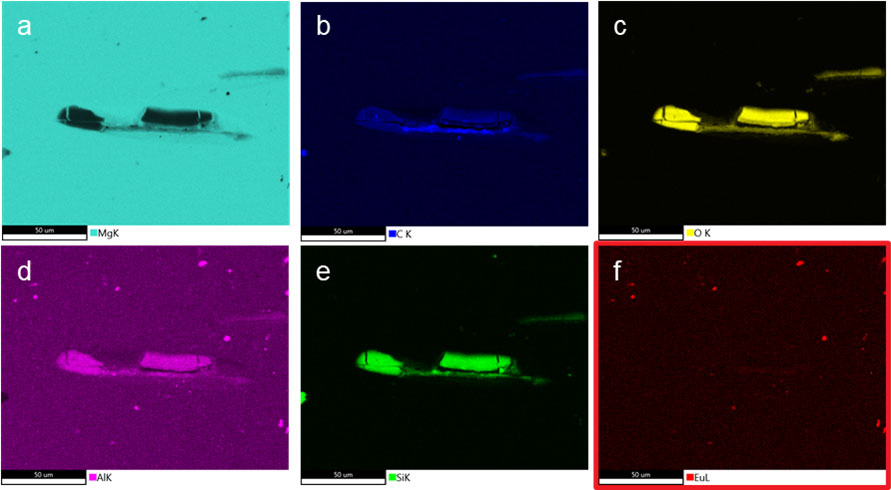
Figure 4. EDS maps for a) Mg, b) C, c) O, d) Al, e) Si, and f) Eu.
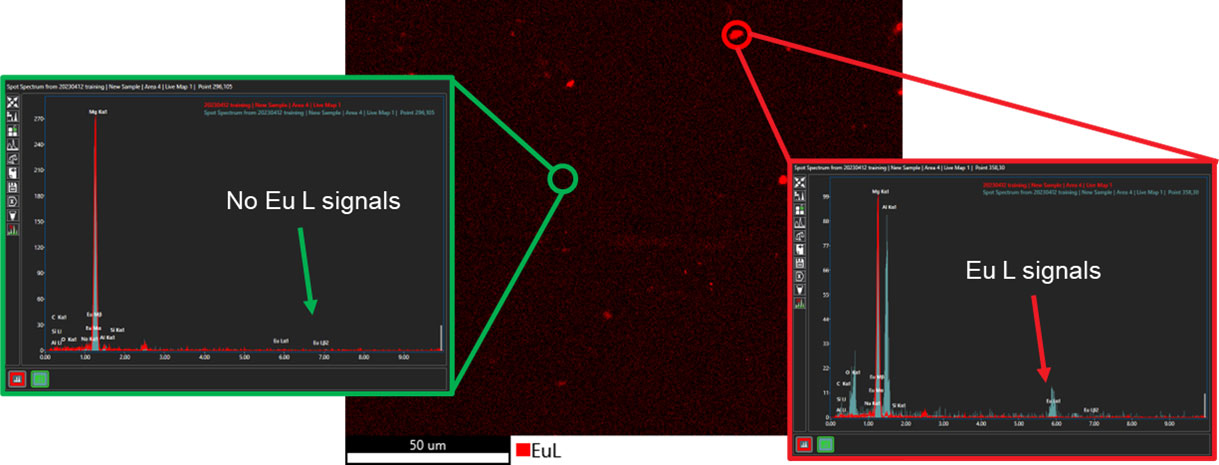
Figure 5. Cumulative spectrum (red spectrum) vs. Maximum Pixel spectrum (cyan spectrum) to show the difference between the Eu region (red circle) and non-Eu region (green circle).
Conclusion
We wrote this interesting demo story to introduce a unique feature in EDAX APEX software, Maximum Pixel Spectrum. We hope this feature will be beneficial to our users and become part of the standard EDS tools for trace element characterization.