Introduction
Stainless steel has applications in areas where surface appearance is an essential property. These may include kitchen worktops, cupboard facings, and cladding for building exteriors and interiors. As stainless steel is mainly used for its appearance, any effect of oxidation must be reduced so that it will not be detrimental to the final product's appearance. Unfortunately, current scale removal processes may not be sufficient to remove all oxides present after slab reheat. These remnants of oxide scale can be pressed into the material's surface during rolling and cause unsightly, which is unacceptable to both the manufacturer and purchaser. This study investigates the scales produced on stainless steel during industrial forming. Electron Backscatter Diffraction (EBSD) and Chemical Indexing Scan (ChI-Scan™), which combines the structural information measured with EBSD with the complete spectrum chemical information measured with Energy Dispersive Spectroscopy (EDS), was used to study the microstructure of the scales and possible phase distributions.
Sample Preparation
Samples of 316L stainless steel were oxidized in a box furnace in laboratory air at 1200 °C for four hours. After oxidation, they were mounted in edge retaining conductive bakelite, metallographically prepared using grades of silicon carbide paper from 80 – 2400 grit, 6 and 1 μm diamond polish, and then finally polished using colloidal silica solution for at least 25 min. It is important to note that the preparation aimed to get the ceramic oxide scale ready to be analyzed. The oxide scale is brittle and requires more careful preparation than a metal sample. The Scanning Electron Microscope (SEM) used to examine samples was a Leo 1530 VP field emission gun with EDAX EDS and EBSD systems located at the Loughborough Materials Characterisation Centre. The working distances and operating voltages were varied to give optimum EDS and EBSD imaging conditions. Figure 1 is an image of a scale taken in backscatter imaging mode.
Phase Identification using ChI-Scan
The backscatter image (Figure 1) of a scale grown on 316L stainless steel after four hours at 1200 °C shows that the scale has three visible layers. The lowest layer appears porous and fine-grained. The middle layer shows a larger grain size, with damage evident from polishing. The upper layer appears less damaged than the middle layer. Although, such an image provides some information about the microstructure. An EBSD image quality (IQ) map (Figure 2) provides more detail about the grain structure.
 Figure 1. Backscatter electron micrograph of an oxide scale formed on 316L stainless steel after four hours at 1200 °C.
Figure 2 shows the same scale as that shown in Figure 1. This image indicates that the oxide layer nearest the substrate (layer 1) is very fine-grained, the middle layer (layer 2) has larger equiaxed grains, and the top layer (layer 3) appears more disordered with some long thin grains at the top edge. However, it isn't easy to precisely distinguish between the three layers with EBSD alone as the phases present have similar crystallographic structures. Combing this IQ map with EDS data collected simultaneously during the EBSD scan provides information (Figure 3) that helps distinguish between the layers and reveals the spatial distribution of phases both between and within the layers.
 Figure 2. EBSD IQ map of an oxide scale formed on 316L stainless steel after four hours at 1200 °C in air and cooled in the air at room temperature.
 Figure 3. EDS maps of a) nickel, b) chromium, c) iron, and d) oxygen in an oxide scale formed on 316L stainless steel after four hours at 1200 °C in air and cooled in the air at room temperature.
From the EDS information shown in Figure 3, it is clear that four discrete chemical phases are contained within the three layers. Figure 3a is a nickel map overlaid on an IQ map. This figure shows that nickel is distributed homogeneously throughout the equiaxed grains of layer 2. However, this is the only layer that shows this type of distribution. Many grains in layer 1 are rich in nickel, but many contain very little nickel. In the upper layer (layer 3), most of the grains have very low nickel content, but many grains along the upper edge of the scale show high nickel content. The chromium map (Figure 3b) indicates that only layer 1 is rich in chromium, while the rest of the scale shows very little chromium. This layer also shows some grains towards the top and bottom of the layer to be higher in nickel content. The iron map (Figure 3c) shows that the iron content increases towards the top edge of the scale. The grains that demonstrate a high nickel content on the top edge of the scale also show a low iron content in relation to the rest of layer 3.
For each of the four discrete chemical phases identified in the EDS maps, a corresponding crystallographic phase was selected from a database of diffraction patterns using the chemical composition and EBSD indexing as search criteria. The four discrete phases were identified as hematite and three spinels – chromium, nickel-iron oxide, and chromium iron oxide. The crystallographic structure information (EBSD) and chemical composition data (EDS) were used together (ChI-Scan) to differentiate these phases during a rescan of the simultaneously collected EDS-EBSD data. The austenitic stainless steel underlying the scale was also considered in the rescan.
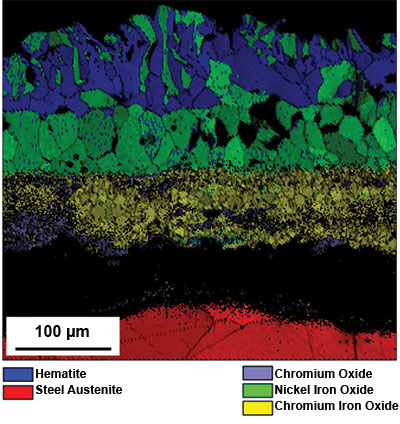 Figure 4. Map of the phases present within a scale formed on 316L stainless steel after four hours at
1200 °C in air and cooled in the air at room temperature.
The resulting phase map in Figure 4 shows the four possible phases within the three oxide scale layers. There is a mixed-phase layer closest to the substrate, a nickel-iron oxide layer in the middle of the scale, and a hematite layer on the top edge of the scale. Some nickel-iron oxide grains are on the top edge of layer 3. It would be reasonably straightforward to index the hematite layer if a phase map were to be attempted without ChI-Scan. This is because it has a different crystal structure (hexagonal) from the rest of the scale, of which the majority are different spinel oxides (face-centered cubic). In contrast, it would be practically impossible to distinguish between the individual spinels using their crystallographic data alone. However, when the EDS information is incorporated into the phase differentiating process using ChI-Scan, the spinels are easily distinguished from one another. The nickel-iron oxide is distinguished based on its high nickel content, the chromium oxide by its high chromium content and low iron content, and the chromium iron oxide by its high content of both chromium and iron.
Conclusion
The capability offered by ChI-Scan to combine EDS and EBSD analysis results enables analysts to differentiate reliably between crystallographically similar and chemically different oxide scales grown on stainless steel samples. The analysis allows process engineers to eliminate the relevant oxide scale from the final product.
Bibliography
Images were taken from:
- M. Jepson & R.L. Higginson (2005) The Use of EBSD to Study the Microstructural Development of Oxide Scales on 316 Stainless Steel, in High-Temperature Materials 22: 195-200
General papers detailing this and similar work on oxide
scales:
- G. D. West, S. Birosca and R. L. Higginson (2005) Phase determination and microstructure of oxide scales formed on steel at high temperature, Journal of Microscopy 217: 122-129
- R. L. Higginson and G. D. West (2005). The Study of Texture Development of High-Temperature Oxide Scales on Steel Substrates using Electron Backscatter Diffraction, Materials Science Forum 495-497: 399-404
- R. L. Higginson, G. D. West and M. A. E. Jepson (2007). The Characterisation of Oxide Scales Grown On Nickel Containing Steel Substrates Using Electron Backscatter Diffraction, Materials Science Forum 539-543: 4482-4487
- S. Birosca and R. L. Higginson (2005) Phase identification of oxide scale on low carbon steel, Materials at High Temperatures 22: 179-184
- R. L. Higginson, M. A. E. Jepson and G. D. West (2006) Use of EBSD to characterise high-temperature oxides formed on low alloy and stainless steels, Materials Science and Technology 22: 1325-1332