Introduction
Eutectic NiAl–(Cr,Mo) composites are promising for high temperature use because they combine a high melting point, good oxidation resistance, and low density. The microstructure consists of an ordered B2 NiAl matrix reinforced by a disordered body centered cubic (bcc) (Cr,Mo) solid solution. Crystallographically, the B2 structure resembles bcc, with two interpenetrating bcc sublattices for Ni and Al. This similarity, together with the fine feature size, makes phase discrimination and nanoscale orientation mapping challenging using conventional electron backscatter diffraction (EBSD).
In this application note, we use transmission Kikuchi diffraction (TKD) coupled with energy dispersive x ray spectroscopy (EDS) and compare Hough indexing (HI), spherical indexing (SI), and SI augmented with EDAX ChI Scan™ (EDS assisted phase assignment) to map the phases and reveal the subgrain structure in a creep tested, nanoscale eutectic NiAl–(Cr,Mo) alloy.
Methods
Material processing. The eutectic NiAl–(Cr,Mo) alloy was cast using the Bridgman process. The material was examined after creep testing.
Specimen preparation. An electron transparent lamella was prepared by Ga⁺ focused ion beam (FIB) lift out.
TKD–EDS data acquisition. TKD and EDS data were collected simultaneously using an EDAX® Velocity™ EBSD detector and an EDAX Octane Elect EDS detector controlled by the EDAX APEX software. A 7 x 6 µm region was mapped with a 10 nm step size, and the specimen was tilted 20° with respect to the horizontal during acquisition.
Indexing and post processing. Patterns were initially indexed by Hough indexing, reindexed by spherical indexing, and then refined by spherical indexing with ChI Scan, in which elemental information from EDS was incorporated for phase assignment using the EDAX OIM Analysis™ (v 9.1) software with OIM Matrix™ module
Results and discussion
Orientation mapping
Hough indexed inverse pole figure (IPF) maps contained clusters of misindexed pixels, especially at grain boundaries and in deformed regions. Spherical indexing reduced these artifacts and produced cleaner orientations with sharper boundary definition (Figure 1).

Figure 1. IPF ND orientation maps of the TKD dataset. Left) Initial Hough indexing shows scattered misindexed pixels at boundaries and in high strain regions. Right) Spherical indexing suppresses these artifacts and sharpens boundary definition.
Subgrain structure
Kernel average misorientation (KAM) maps (Figure 2) derived from HI made the subgrains difficult to distinguish. The higher angular precision of SI revealed the low angle subgrain boundaries, which were masked by the angular orientation noise in the HI KAM map.
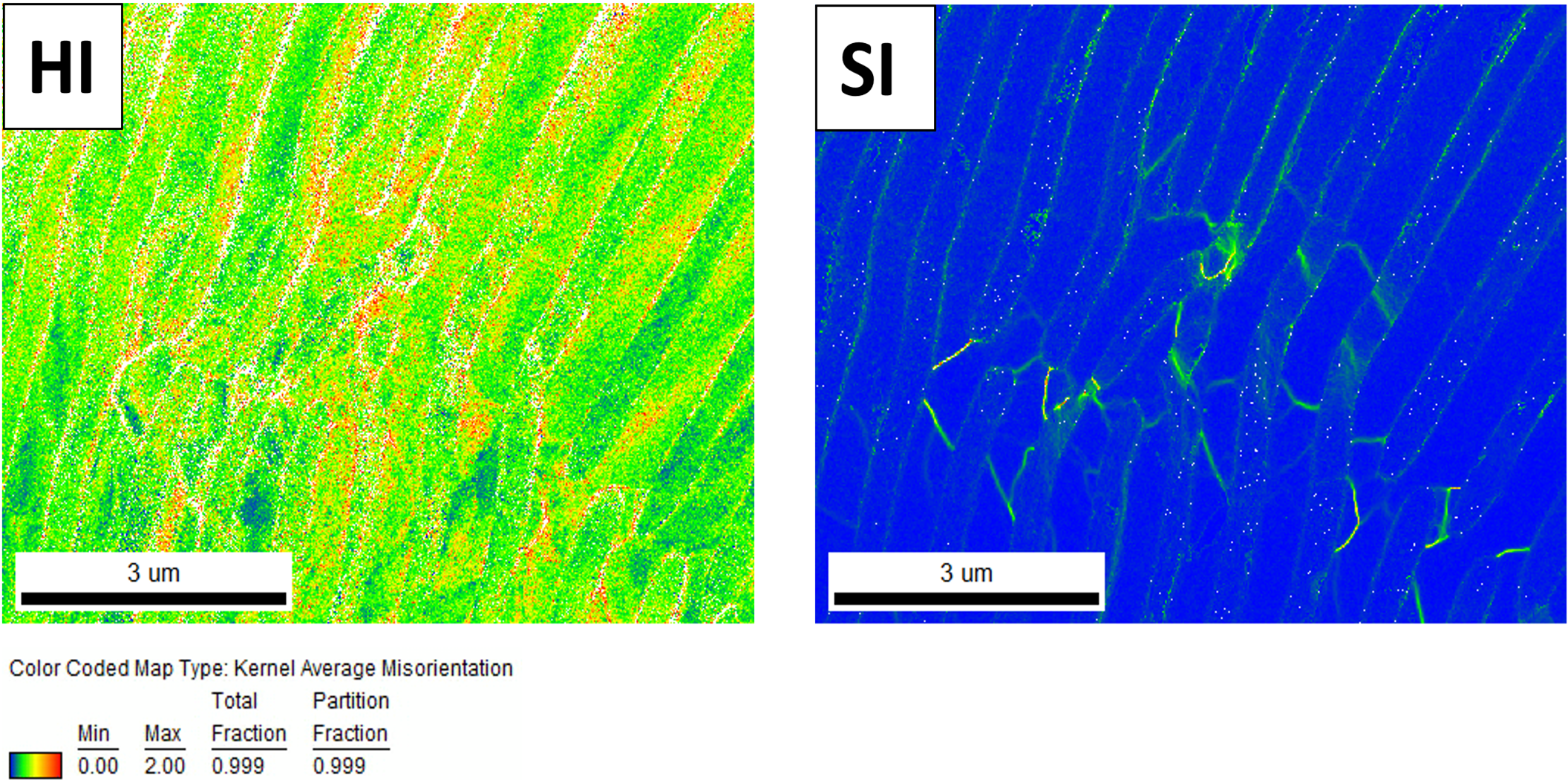
Figure 2. KAM maps (0 – 2°) created from HI (left) and SI (right). The improved orientation precision with SI resolves low angle subgrain boundaries that appear diffuse or fragmented in the HI based map.
Phase mapping without EDS assistance
Because B2 NiAl and bcc (Cr,Mo) are crystallographically similar, both HI and SI struggled to separate the phases reliably. SI offered a slight improvement over HI, but phase misassignments remained (Figure 3).
Simulated master patterns for B2 and bcc show only subtle differences in band intensities, while the experimental electron backscatter patterns (EBSPs) collected under these conditions do not exhibit strong fine structure contrast (Figure 4). This explains why purely pattern based approaches had difficulty with phase discrimination for this alloy.

Figure 3. Phase maps produced with HI (left) and SI (right). Due to the crystallographic similarity of B2 NiAl and bcc (Cr,Mo), SI yields only a modest improvement and some misassignments persist.

Figure 4. Simulated master patterns for B2 NiAl and bcc (Cr,Mo) exhibit only subtle band intensity differences; the representative experimental EBSP lacks the fine structure contrast needed for reliable phase discrimination.
EDS assisted reindexing (ChI-Scan)
A blended EDS map clearly delineated the NiAl rich and (Cr,Mo) rich regions. Incorporating this elemental context through ChI Scan during SI enabled correct phase assignments without compromising orientation quality (Figure 5).

Figure 5. Blended EDS map (NiAl in purple; (Cr,Mo) in green) used during SI with ChI-Scan. Incorporating elemental context enables correct phase assignment in the final phase map while maintaining orientation quality.
Conclusion
TKD provides the spatial resolution required to probe nanoscale lamellae in the eutectic NiAl–(Cr,Mo) composite. Spherical indexing increases indexing success and orientation precision relative to Hough indexing. ChI‑Scan leverages the EDS signal to separate crystallographically similar phases that pattern‑only methods cannot reliably distinguish. Together, these hardware and software tools enable confident mapping of phases, orientations, and low‑angle subgrains in this nanoscale alloy.
Acknowledgement
We thank Dr. Steffen Neumeier (Institute for General Materials Properties, Friedrich Alexander Universität Erlangen Nürnberg) for the sample, and Dr. Johan Westraadt (Center for Electron Microscopy and Analysis, The Ohio State University) for the characterization and analysis.