Introduction
Electron Backscatter Diffraction (EBSD) is extensively used for orientation and microstructure characterization of crystalline materials ranging from metals to ceramics and minerals. With new EBSD detector developments, the interest in performing EBSD analysis on beam-sensitive materials is increasing. Examples of such materials are organic photovoltaics and biominerals where higher intensity electron beams can quickly damage the crystal structure, thus making EBSD impossible. The Clarity™ EBSD Detector, the world’s first commercially available direct electron detector for EBSD applications, enables true low-dose EBSD, to open up the possibility for characterization of these types of crystalline materials.
Results and Discussion
To push the limit of EBSD data collection with minimal high tension and electron dose, it is important to know how much signal is needed to generate an indexable diffraction pattern. Dynamic simulations of the
diffracted signal suggest that patterns with only one electron per pixel on average can already produce indexable patterns (Figure 1).

Figure 1. Simulated Si EBSD pattern with an average of one electron per pixel using only diffracted electrons.
However, a large part of an EBSD pattern signal is background. These are electrons that get scattered at the sample surface and reach the detector without contributing to bands in the pattern. The ratio between electrons in the bands and the background determines the minimum required electron dose. The unprocessed EBSD patterns of Be and Au (Figure 2) illustrate this difference.

Figure 2. Unprocessed Be (top) and Au (bottom) EBSD patterns with corresponding 3D intensity plots.
The bands are easy to see in the Au pattern and approximately 20% brighter than the background signal. In the Be pattern, the bands are very weak and barely brighter than the background intensity cone. This means that Be effectively needs a higher electron dose to obtain an indexable pattern than for Au. EBSD patterns of average atomic number materials exhibit a band-to-background ratio between these extreme examples, typically around 1:10. Considering that only one electron per pixel in the diffracted signal is enough to see the bands, an average electron dose on the EBSD detector of 10 electrons per pixel is indexable (Figure 3).

Figure 3. (left) EBSD pattern with average 10 electrons per pixel and (right) IPF map of 3D printed steel collected using 13 pA beam current.
However, this only works when you have a perfect crystal and no signal loss. In practice, this means that you can reliably index with an electron dose of 20 – 50 electrons per pixel on most materials.
In addition to the band-to-background ratio, the overall intensity of observed EBSD patterns depends on the material's backscatter coefficient. Light materials not only produce less intense EBSD patterns, but also, the fraction of electrons that carry diffracted information is lower, thus requiring a longer exposure to the electron beam (Figure 4).

Figure 4. Simulated EBSD patterns and chart illustrating the different diffracted intensities and required exposure time to reach an average of 50 diffracted electrons per pixel using 100 pA beam current at different kV - assuming ideal crystal, surface, and detection efficiency.
For experimental patterns, the required exposure time shows a clear increase at lower kV (Figure 5). The curves in the chart point to a final effect that needs to be considered. The exposure times are constant at beam energies above 20 kV, but the required exposure times increase with decreasing electron energies. This is a combined effect of the diffracted intensity and the lower EBSD detector efficiency at decreasing kV.

Figure 5. Experimentally determined exposure times for different materials at constant beam current.
The effects described above give a clear limit of the minimum electron dose required to analyze metals. Minerals and ceramics are typically lighter and therefore need a little more signal.
Biominerals and crystals containing organic components, such as certain photovoltaic perovskites, may exhibit another complicating factor. In many cases, organic material is present in between or incorporated within the crystals of interest. Such organic structures may disintegrate upon exposure to a high-intensity electron beam, and the resulting damage and contamination to the material then prevent successful EBSD phase and orientation analysis. Minimizing the electron dose mitigates these effects.
The interest in low-dose EBSD analysis focuses on two main applications: 1. Minimizing the interaction volume in the sample to improve the lateral resolution and 2. Enabling orientation analysis of beam-sensitive materials. In the examples below, a Clarity EBSD detector was used. In addition, off-line NPAR™ processing was applied to maximize the indexing performance in areas with a rough surface.
The map in Figure 6 shows the microstructure in the transition zone from calcite to the aragonite nacre in an Atrina Pectinata shell. Mollusk shells and the aragonite nacre in particular, are highly sensitive to the electron beam and require low-dose conditions for successful analysis.
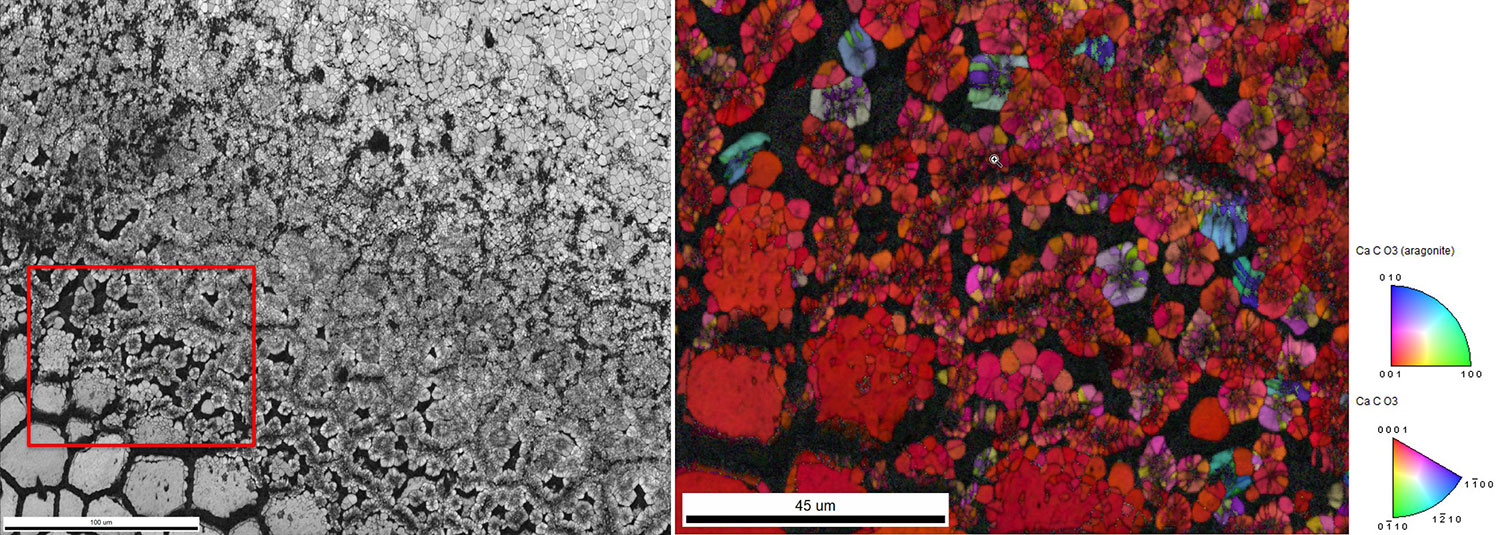
Figure 6. (left) EBSD Image Quality map showing the transition zone from columnar calcite (lower left) to planar aragonite nacre (top right). (right) The detailed Inverse Pole Figure map illustrates the grain microstructure directly at the calcite-aragonite contact.
At the calcite-aragonite contact, a complex microstructure of calcite subgrains that appear correlated with aragonite grains of similar size is present. The aragonite grains first form along the edges of the calcite crystals and then coalesce into full polycrystalline covers of the columns. As a final step, the small aragonite crystals are covered by equiaxed planar aragonite crystals that form the smooth nacre structure that coats the shell’s inside.
The first appearance of aragonite between the calcite pillars was visualized in detail using a 12 kV, 250 pA electron beam (Figure 7).
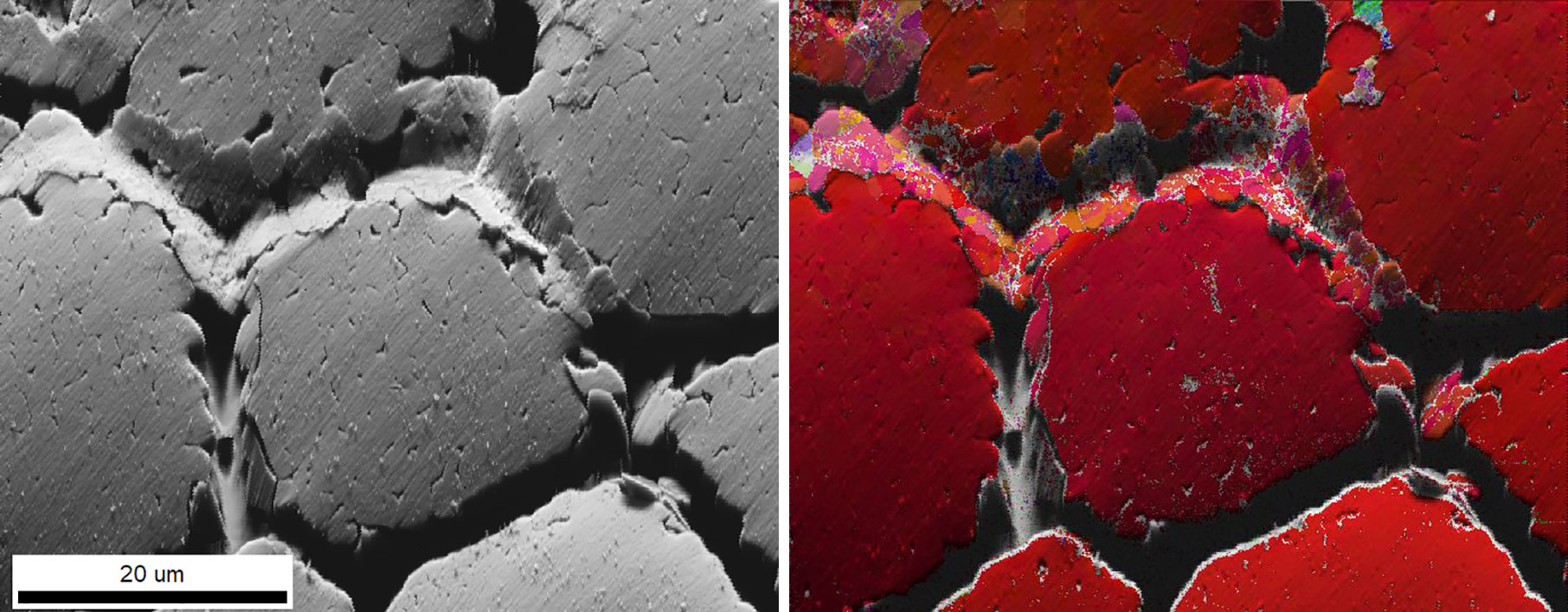
Figure 7. (left) Image Quality (IQ) map with (right) superimposed IPF map of aragonite platelets in between calcite pillars.
Low-dose EBSD is also necessary to investigate different perovskite materials for their photoelectronic properties. Figure 8 shows the microstructure of an inorganic halide perovskite (CsPbI3). The SEM image shows sintered grain clusters on a glass substrate that exhibit a radial structure from a central point. EBSD was used to determine if these clusters maintained multiple orientations, which reflect the original crystal orientations prior to sintering, or if the sintering process involved full recrystallization. The IPF colors in Figure 8 indicate that most clusters only show a single color, which confirms that full recrystallization has taken place.

Figure 8. (left) SEM image and (right) IPF map of CsPbI3 halide perovskite collected using 15 kV and 300 pA electron beam. The larger grains are an orthorhombic phase; in between these grains, a small fraction of a cubic phase was observed. Sample courtesy of Dr. Julian Steele (KU Leuven, Belgium).
Conclusion
The beam intensity limit for low-dose EBSD is defined by the ratio of the diffracted bands over the background signal. This ratio increases with the backscatter coefficient. For materials with diffraction intensities similar to iron alloys, indexable EBSD patterns can be obtained with as few as 10 e-/pixel. For lighter materials, 20 - 50 electrons are required.
The EDAX Clarity Direct Electron Detector is ideally suited to investigate beam-sensitive materials under low-dose beam conditions that minimize damage to sensitive materials.