Introduction
Increasing gasoline prices continue to drive consumers to purchase more fuel-efficient vehicles. Reducing the weight of an automobile by 10% improves fuel efficiency by 6 – 8% and reduces greenhouse gas emissions. Weight reduction is achieved through the increased development and use of lightweight structural materials. For vehicle designers, it is important to develop materials and manufacturing processes that not only reduce weight but also maintain the strength required to meet crash safety testing. In addition, they must do so without raising the cost of the vehicle beyond an acceptable level.
Background
The development and use of lightweight structural materials and the optimization of manufacturing and production processes require the measurement of key microstructural parameters.
- Grain size is traditionally measured using optical microscopy which requires alloy-specific chemical etching. This etching may not reveal all the grain boundaries. Furthermore, it employs chemicals with special handling and disposal requirements.
- Phase distribution is traditionally measured using optical or electron microscopy. These measurements infer phase by measured grayscale level rather than by providing a direct measurement of structure and composition. Multiple chemical etching treatments may be required to reveal all phases present.
- Crystal orientation on an individual grain is traditionally measured by transmission electron microscopy (TEM). TEM analysis requires specialized sample preparation techniques, tools, and expertise. Orientation measurements are generally done manually which limits the number of measurements that can be collected.
- Texture, the presence of preferred orientations, is generally measured by x-ray diffraction (XRD). Texture measurements with XRD do not provide spatially specific orientation measurements but rather a collective sample orientation with the measurement volume.
- Plastic strain, the change in orientations within grains due to an applied load, is traditionally measured by TEM. The analysis area of TEM is limited. TEM samples are generally 3 mm in diameter, and the portion of the sample thin enough for TEM analysis is smaller than this. The lack of automated measurements further limits data collection.
In contrast, electron backscatter diffraction (EBSD) provides a fast and automated solution to measure lightweight material microstructure. The advantages of EBSD include:
- Direct grain size measurement using discrete orientation measurements to remove ambiguous grain boundary determination errors. Specific grain boundary types, such as twin boundaries or phase transformation orientation relationships, can also be identified to help understand deformation and/or heat-treating processes.
- Direct phase distribution measurement by measuring crystallographic structure using EBSD and chemical composition using energy dispersive x-ray spectroscopy (EDS). ChI-Scan™, the combined use of EBSD and EDS for phase mapping, provides accurate phase distributions even for complex lightweight materials, such as advanced steels and Al-Si castings.
- Direct measurement of crystal orientation and texture. Automated measurements with speeds up to 6,700 points per second on alloys allow for rapidly collecting a statistically significant data set. Maps for visualizing the spatial distribution of orientations are easily produced. Texture information is obtained simultaneously to remove the need for additional analysis time.
- Direct measurement of plastic strain with orientation precision values less than 0.1° are obtainable. Orientation precision data allows for better understanding and optimization of the deformation processes active during forming and fabrication processes used to integrate lightweight materials into automotive designs. The automated analysis of areas greater than 1 cm x 1 cm allows visualization of deformation over large areas and cross-sections to understand how plastic strain and deformation are distributed within a material.
Results and Discussion
Steel, aluminum, and magnesium alloys are the primary structural materials used to reduce automotive weight. While the density of steel is the highest of these three alloys, its mechanical properties and formability make it desirable for crash protection. Advanced high-strength steels have been developed using microalloying and continuous annealing or other thermo-mechanical processing techniques. The resulting materials exhibit improved strength and toughness both to reduce weight and maintain safety. One example of advanced engineered steel is twinning-induced plasticity (TWIP) steel. TWIP steels are designed to absorb more energy in a crash than traditional steels while maintaining strength and stability. This property is the result of deformation twinning that occurs during a crash, thereby increasing the yield strength of the material.
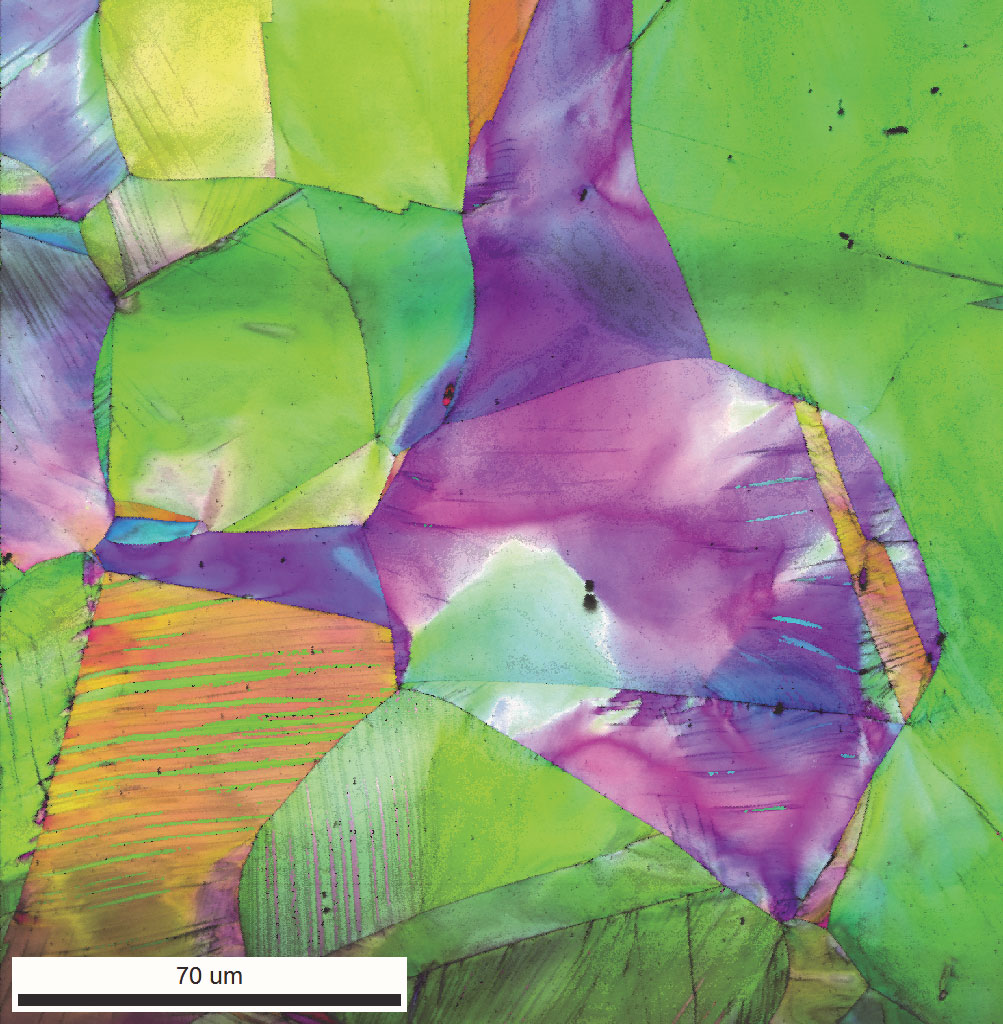 Figure 1. Orientation map of TWIP steel showing twin boundaries introduced during deformation.
As shown in Figure 1, EBSD is used to measure the microstructure and twin boundaries present in the steel before and after deformation to improve and optimize the processing conditions. Dual-phase steels (DPS) have two-phase microstructures that provide high strength with better formability. EBSD measures the phase distribution (Figure 2) to help optimize the heat treatment used during production.
 Figure 2. EBSD image quality map of dual-phase steel showing duplex microstructure.
With a significantly lower density than steel, aluminum offers great potential for weight reduction. Formability is a key consideration. Crystallographic texture affects the feasibility of stamping as a manufacturing technique. Texture can be controlled through processing parameters to improve formability. The use of cast aluminum alloys for engine blocks has significantly reduced weight. Developing new alloys for higher temperature applications requires the determination and measurement of the phases that develop in these alloys, both during casting and while in use at high under-hood temperatures.
Magnesium also offers an appealing combination of high strength and low density; however, to be useful, manufacturing challenges must be overcome. Wrought magnesium alloys generally have a (0001) texture, which creates anisotropic material properties. Figure 3 shows an orientation map of wrought magnesium. Improvements in formability are needed. EBSD is used to understand the effects of alloying and deformation rate and temperature on formability to make magnesium a viable lightweight material.
 Figure 3. Orientation map of wrought magnesium exhibiting (0001) texture.
The integration of new lightweight structural materials into automotive designs also requires that these new materials be joined together reliably with traditional materials. This joining must not compromise strength or safety and must be cost-efficient. EBSD data helps to optimize the joining process to produce a high-quality joint.
Conclusion
EDAX Pegasus systems are recommended to help engineers and scientists develop the materials and manufacturing processes necessary to fulfill the challenging requirements of lightweight structural materials. Pegasus systems offer integrated EDS and EBSD characterization with an easy-to-use interface for comprehensive analysis of material chemistry, crystallography, and phase distribution. Velocity EBSD cameras provide fast, sensitive, precise, and smart EBSD pattern collection, resulting in reliable high-quality data to facilitate new materials discoveries.