Introduction
The development of functional, engineered nanoparticles is exciting for a wide range of medical, drug delivery, and chemical sensing applications. Among these, gold (Au) nanoparticles (NPs) have garnered significant attention due to their, unique functional properties, and ease of synthesis—their intrinsic features (optical, electronic, and physicochemical characteristics) can be altered by changing morphological parameters such as shape, size, and aspect ratio.
To further enhance these properties, researchers are investigating gold-semiconductor nanohybrids for use in surface-enhanced Raman spectroscopy (SERS)-based technologies for ultra-sensitive label-free detection and identification of molecular analytes. Specifically, nanohybridization of Au NPs with 2D materials, such as graphene or transition-metal dichalcogenides, e.g., tungsten disulfide (WS2), has been shown to increase the likelihood of Raman scattering by several orders of magnitude due to the synergy of plasmonic and chemical enhancement mechanisms. Consequently, Au-WS2 nanohybrid NPs have emerged as highly promising candidates due to their exceptional signal enhancement capabilities for targeted analytes.
There are several fabrication strategies for Au-WS2 nanohybrids currently under development, ranging from simple blending of chemically synthesized Au NPs and exfoliated nanoflakes of WS2 to the epitaxial overgrowth of WS2 on Au NPs by chemical vapor deposition (CVD). Establishing a clear link between functional properties and the spatial distribution and interaction of Au NPs and WS2 is critical. To achieve this, researchers employ scanning (SEM) and transmission electron microscopy (TEM) techniques to image samples with high spatial resolution and use analytical methods, such as electron energy loss spectroscopy (EELS) or energy dispersive x-ray spectroscopy (EDS) to reveal the distributions of Au, W, and S.
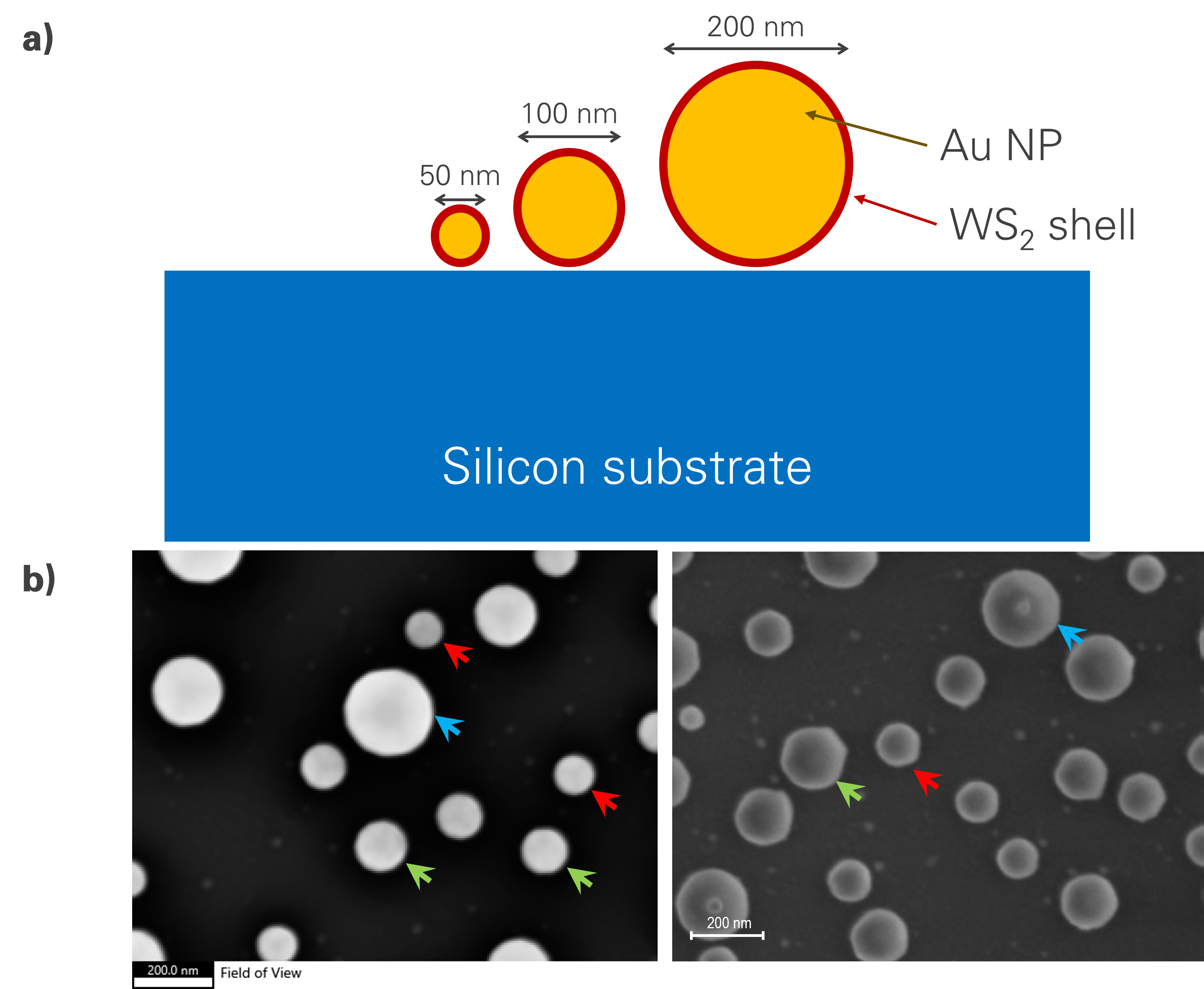
Figure 1. a) Schematic representation of the Au-WS2 nanohybrid particles in cross-section; a tungsten sulfide (WS2) shell is formed around gold nanoparticles of various sizes. The particles are sat on a silicon wafer substrate. b) Top-down secondary electron images of the nanohybrid particles examined in the SEM with Octane Elite Ultra EDS system (left) and other EDS system (right). Particles with diameters of 200 nm (blue arrow), 100 nm (green arrows), and 50 nm (red arrows) were observed.
While EELS in the TEM offers exceptional spatial resolution and chemical sensitivity, it requires significant capital investment and provides limited statistical information. On the other hand, EDS in the SEM enables high-throughput analysis at relatively low cost, making it an attractive option for screening. However, there are some significant technical challenges in analyzing nanoparticles that need to be overcome:
- Small particle size (10 – 200 nm diameter): Nanoparticles interact weakly with the electron beam, producing few characteristic x-rays, which demands highly efficient signal detection.
- Complex sample topography and variable thickness: Variations in scattering cross-section cause x-ray yield to fluctuate with beam position, complicating interpretation of elemental maps unless corrected.
- Spectral line overlap: Distinguishing gold from sulfur and tungsten from silicon (commonly used as a substrate) is difficult due to strong overlaps between Au-M and S-K lines (2.120 and 2.307 keV, respectively) and Si-K and W-M lines (1.740 and 1.774 keV, respectively).
The objective of this study is to evaluate the capabilities of the Octane Elite Ultra to perform elemental mapping of Au-WS2 nanohybrid particles deposited on a silicon substrate.
Materials and methods
Au-WS2 nanohybrids were fabricated by CVD growth of WS2 on Au NPs of 50, 100, and 200 nm in diameter; the Au-WS2 nanohybrids were deposited onto a silicon wafer for analysis (Figure 1). The same sample was analyzed sequentially in two different field emission SEMs; one fitted with an Octane Elite Ultra and the other with a commercially available large area (>1 Sr) EDS system from another vendor.
Results
Both EDS systems produced elemental maps (Figure 2) showing three distinct sizes of Au NPs on the silicon substrate. However, the maps captured by the ‘other’ detector exhibited some strong diplopia (double vision), likely an artifact arising because of the sample’s topography.
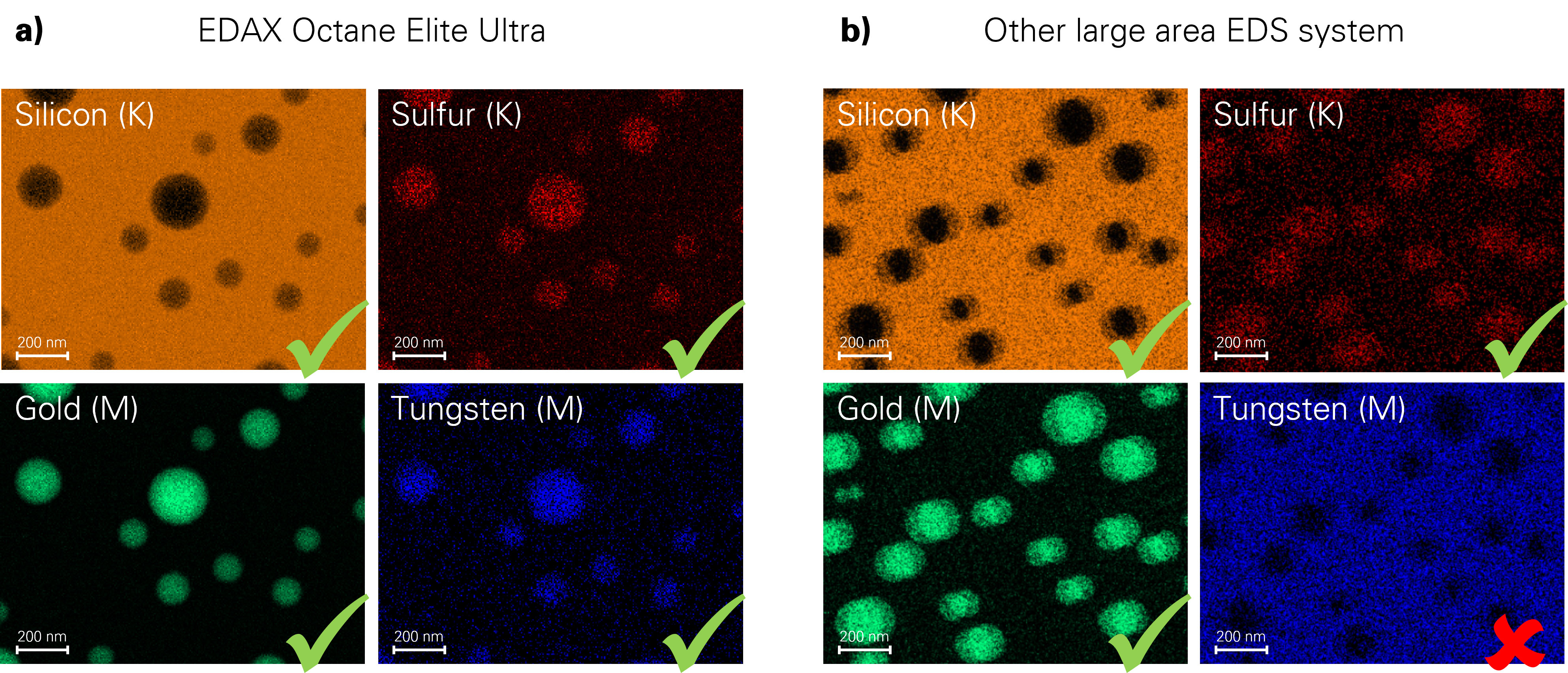
Figure 2. Elemental maps of silicon, sulfur, gold, and tungsten collected by a) the Octane Elite Ultra EDS system and b) a large area EDS system from another manufacturer. The Octane Elite Ultra reveals the WS2 distribution successfully, whereas the other system does not separate the overlapping silicon and tungsten signals. The EDAX data was collected at 20 kV and the elemental maps presented have the Bremsstrahlung background removed and are corrected by the x-ray yield. Elemental maps collected by the ‘other’ detector were captured at 5 kV.
Both detectors demonstrated the presence of sulfur at each NP confirming that the Au NPs had been converted into nanohybrids. However, only the Octane Elite Ultra detector was able to accurately reveal the presence of tungsten—and therefore tungsten disulfide—in the nanohybrid particles. The low abundance of tungsten, presence of silicon as a substrate, and smaller energy difference between Si-K and W-M (0.034 keV) than Au-M and S-K (0.187 keV) presented a severe challenge for the analytical systems. The Octane Elite Ultra detector successfully distinguished the tungsten signal from the silicon substrate at all accelerating voltages used in the investigation (Figure 3).
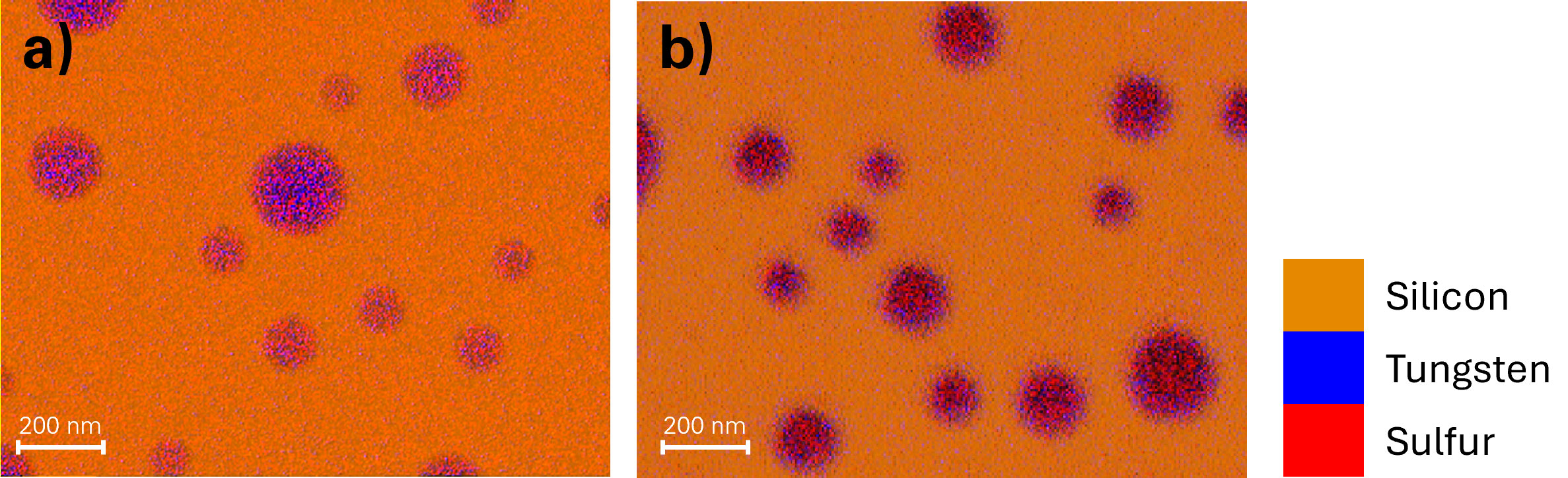
Figure 3. Composite images of silicon, sulfur, and tungsten elemental maps collected by the Octane Elite Ultra EDS system at a) 20 kV and b) 3 kV. The gold map has been excluded for clarity. The formation of gold-tungsten sulfide nanohybrids from gold nanoparticles was confirmed in all cases.
Conclusion
The Octane Elite Ultra confirmed the formation of Au-WS2 nanohybrids with diameters of 50, 100, and 200 nm. Elemental analysis established the presence of tungsten and sulfur at all nanoparticles, detector's confirming the formation of nanohybrid particles consisting of a gold core and thin tungsten disulfide shell. The large active area allowed collection of elemental maps with good signal-to-noise ratio at both low and high accelerating voltages. Unlike the ‘other’ large area EDS detector, the Octane Elite Ultra successfully distinguished tungsten in the tungsten sulfide shell of the nanohybrid from the silicon substrate, owing to its excellent energy resolution and powerful analysis software.
Acknowledgement
Sample provided courtesy of NTUST.