Introduction
The role of solidification in the development of microstructures and material properties is becoming more critical as processing techniques, including additive manufacturing, that involve solidification are becoming more prevalent. In this work, based on a paper by Ezemenaka and Genau (Journal of Crystal Growth 577 (2022) 126389), an Al-Cu-Mg alloy processed via directional solidification has been characterized using simultaneously collected Energy Dispersive Spectroscopy (EDS) and Electron Backscatter Diffraction (EBSD) to investigate the phase and orientation relationships that develop in this ternary eutectic alloy.
Results and Discussion
Samples with a eutectic composition (Al – 15.5 at% Cu – 10.6 at% Mg) were melted in an electric furnace and directionally solidified using a Bridgman-type furnace, where solidification conditions were controlled to establish a stable microstructural growth pattern. Examples shown here are from a sample with a 49 mm growth height. Transverse sections parallel to the solidification direction were prepared for EBSD analysis, first by mechanical polishing down to 0.1 µm diamond paste, followed by 2 hours of polishing with 0.05 µm colloidal silica on a vibratory polisher. Final EBSD preparation was performed using a Gatan PECS™ II Broad Beam Ion Polisher via a 2-step milling routine. The sample was first milled with a 4 kV argon beam with a 4° glancing angle for 10 minutes, followed by a 2 kV beam at 4° for 60 minutes.
EBSD data was collected using a Clarity™ Direct Detector operating at 20 kV acceleration voltage and approximately 1 nA beam. EDS data was collected simultaneously with the EBSD data using an Octane Elite Detector. The microstructure is visualized by the three PRIAS™ images shown in Figure 1.
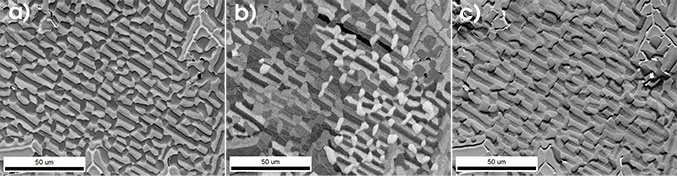
Figure 1. a) PRIAS top ROI image showing atomic number contrast, b) PRIAS middle ROI image showing orientation contrast, and c) PRIAS bottom ROI image showing topographic contrast for the directionally solidified Al-Cu-Mg alloy.
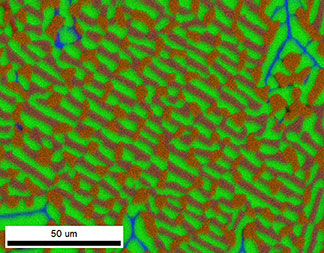
Figure 2. Composite EDS RGB map where the red channel corresponds to the copper signal, the green channel corresponds to the aluminum signal, and the blue channel corresponds to the magnesium signal.
Figure 1a shows atomic number contrast from the sample in the top region of interest (ROI) from the PRIAS image. Figure 1b shows the center ROI PRIAS image, which displays orientation contrast from the different grains and phases. Figure 1c highlights the surface topography present on the sample after preparation in the bottom ROI PRIAS image. This multi-phase sample exhibits surface topography due to the differential polishing rates of the constituent phases.
The EDS information was used for ChI-Scan™ analysis for the most accurate and efficient phase mapping, as shown in Figure 3. NPAR™ was also applied during the ChI-Scan indexing to improve the signal-to-noise ratio of the saved EBSD patterns and subsequent indexing results. The phase map shows the expected two-lamellar/one-rod pattern standard in this ternary eutectic alloy. The aluminum and Al2CuMg phases form the lamellar phases, and the Al2Cu forms the rod phase. The grain size and morphology of each phase are easily measured with this EBSD data. A cored Al-Si-Mg phase was also detected and is attributed to contamination from an unknown source.
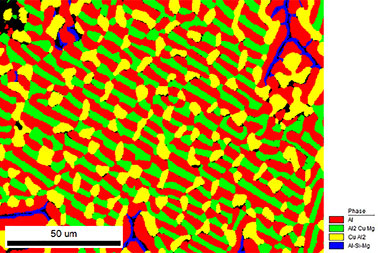
Figure 3. Phase map of the ternary eutectic Al-Cu-Mg alloy measured using combined EDS-EBSD data via ChI-Scan analysis.
Inverse Pole Figure (IPF) maps for the aluminum, Al2CuMg, and Al2Cu phases are shown in Figure 4, with the orientations colored relative to the normal direction of the analysis surface. These orientation maps show a strong preferred orientation for each constituent phase.
Analysis of these orientations shows that the [001] crystal direction of the aluminum phase is parallel with the [001] direction in the Al2Cu and also parallel with the [100] direction in the Al2CuMg phase. These orientation relationships can be visualized by plotting the colored orientations in inverse pole figures for each phase, as shown in Figure 5. It is also interesting to note that by comparing Figures 3 and 4, it is observed that aluminum grains adjacent to the cored Al-Si-Mg phase have an orientation that deviates from both the other grains and the expected orientation relationships.
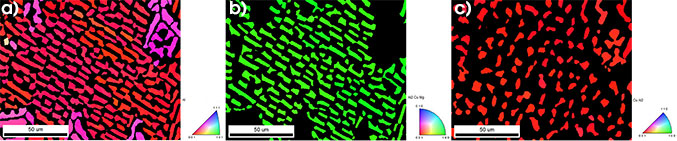
Figure 4. IPF orientation maps for the a) aluminum, b) Al2CuMg, and c) Al2Cu phases, with the orientations colored relative to the surface normal direction of the measured surface.
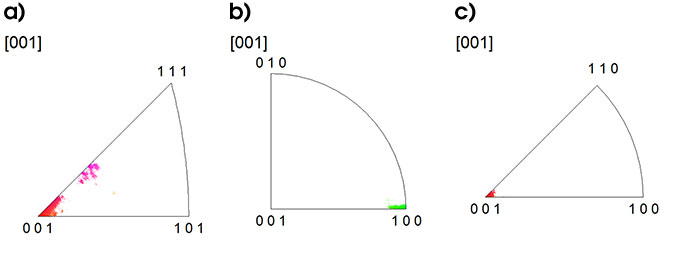
Figure 5. IPF plots for the a) aluminum, b) Al2CuMg, and c) Al2Cu phases, with the orientations colored using the same color scheme from Figure 4.
Conclusion
This work shows how combined EDS and EBSD can be used to fully characterize the orientations and orientation relationships present in a complex ternary eutectic alloy prepared by directional solidification. The application of the Clarity, Octane Elite, ChI-Scan, and NPAR processing allows for optimal EBSD pattern indexing from each phase present for accurate results. We want to acknowledge the kind permission from Dominic Ezemenaka, previously at the University of Alabama at Birmingham and now at the University of Alabama, for providing the samples and sharing the EBSD data.