Introduction
Additive manufacturing (AM), or 3D printing, is a growing manufacturing technique to produce near-net-shape parts in an affordable manner relative to traditional fabrication routes. Different AM processing methodologies include laser or electron beam powder bed fusion, directed energy deposition, binder jetting, and fused deposition. Each of these approaches has a wide range of build variables, which can determine the resulting microstructure of the printed component. This microstructure in turn will help define the material properties and behavior of the part in service.
Electron backscatter diffraction (EBSD) and energy dispersive spectroscopy (EDS) are valuable tools in electron microscopy to characterize the microstructure of these materials to facilitate the understanding of these processing-microstructure-properties relationships. In this work, the microstructural development in Inconel 718, a nickel-chromium-based superalloy used in aerospace applications, built using coaxial wire-feed laser metal deposition is analyzed using 3D EBSD and EDS.
Discussion
EBSD and EDS data was collected using an EDAX Velocity EBSD detector and an EDAX Octane Elite EDS detector installed on a Thermo Fisher Scientific Helios Xe-based Plasma FIB-SEM. Plasma focused ion beams (FIBs) allow for faster material removal rates and enable larger volume analysis. For 3D collection, EBSD and EDS data is collected from the sample in the same manner as routine 2D analysis, where an area and sampling step size define the collection parameters. EDS data can be simultaneously collected during the EBSD acquisition process. The FIB then removes a slice of material, and the EBSD-EDS collection process is repeated on the new surface.
 Figure 1. 3D IPF orientation map colored relative to the build (Z) direction.
Integrated software controlling both the microscope and EDAX acquisition process repeatedly positions and aligns the sample for both milling and analytical geometries. In this example, the volume analyzed was approximately 60 μm3, using a 200 nm step size for each 2D EBSD scan, and a 100 nm slice thickness. Backscatter electron (BSE) images were collected with every slice, and EBSD-EDS data was collected every other slice, resulting in 200 nm2 voxels for the EBSD-EDS data. With the Velocity detector acquiring EBSD data at 1,000 points per second (pps), the collection time per cycle was 60 s for each milling slice, 15 s for BSE imaging, and 90 s for EBSD-EDS mapping. The total collection time was approximately 48 hours for 600 slices, plus additional time for sample movement and alignment between positions. This highlights the importance of fast EBSD acquisition. In this case, 1,000 pps was selected to increase the EDS sampling statistics. On an Inconel 718 sample, indexing speeds of up to 6,700 pps can be achieved with the EDAX Velocity Ultra camera, and would significantly reduce both the collection time per slice and overall collection time.
 Figure 2. A rotated view of the 3D volume and the selection of different slicing planes.
Once the 3D data is acquired, OIM Analysis™ provides a suite of tools to enable comprehensive and customizable analysis of the 3D volume. OIM Analysis offers the widest range of maps and grain boundary visualization options to visualize the crystallographic and compositional nature of the measured microstructure. Once the metrics of interest are determined, these can be saved as OIM template files, which save the types of maps and any customized preferences. These template files can then be used with the OIM batch processor to efficiently analyze the data from each slice. The batch processor also includes functionality for slice-to-slice alignment, data cropping, and data cleanup. Finally, OIM Analysis has an optional 3D visualization module that can correlate the 2D slices into a 3D volume rendering, and generate 3D statistics on metrics, including grain size and local misorientation.
Figure 1 shows a 3D inverse pole figure (IPF) orientation map colored relative to the build (Z) direction. Using the 3D visualizer, this volume can be rotated and sliced in any of the three primary reference directions. This allows for visualization of microstructural changes through the material. Figure 2 illustrates a rotated view of this volume and the selection of different slicing planes. By correlating the measured orientation between slices, OIM Analysis can calculate grains in 3D. This provides 3D grain size distributions but also allows for selection and visualization of individual grains. Figure 3 shows two different grains from this microstructure. Figure 3a depicts a typical near-equiaxed grain while Figure 3b shows a thinner twinned grain.
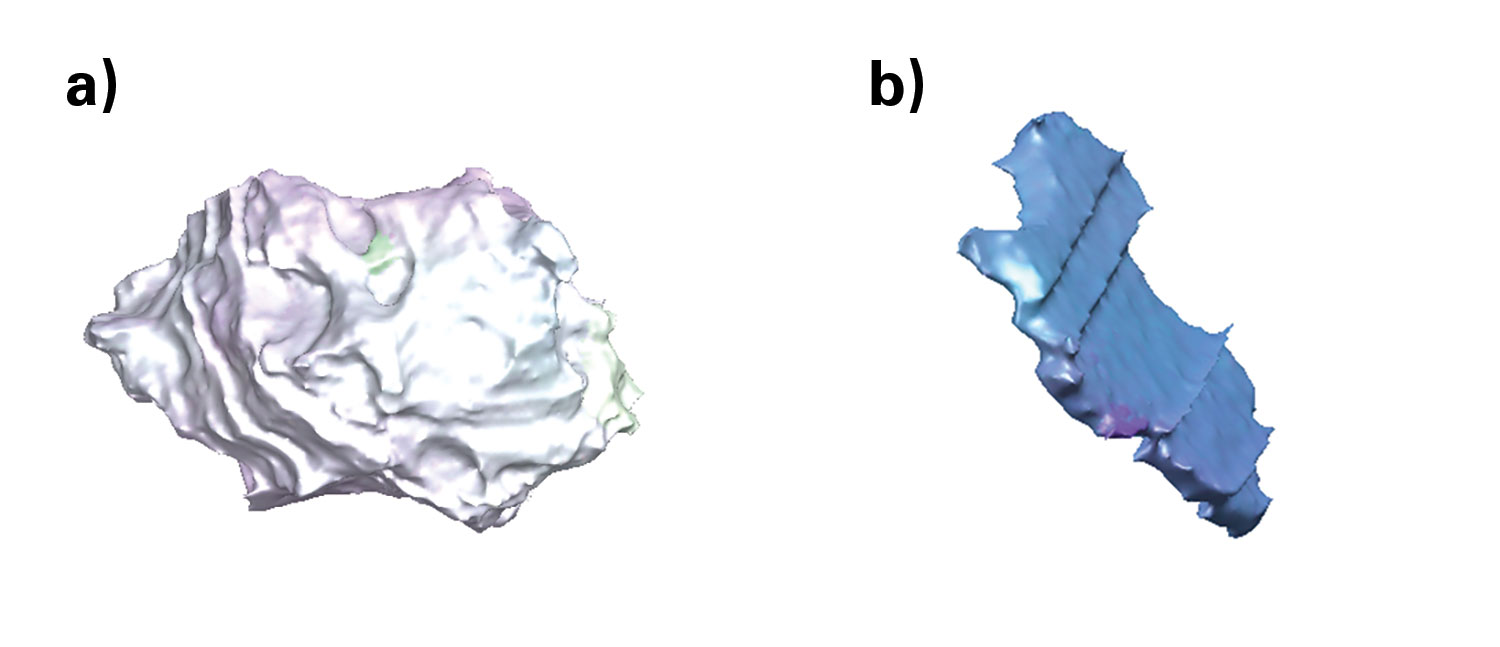 Figure 3. Two different grains from this microstructure. a) Depicts a typical near-equiaxed grain and b) shows a thinner twinned grain.
Local misorientations can also be investigated in 3D. Figure 4 shows a kernel average misorientation (KAM) map in 3D. This image reveals higher local misorientation near grain boundaries and within a precipitate in the microstructure. This can be correlated with the simultaneously collected EDS data as shown in Figure 5. In this image, the RGB map colors the red channel with the niobium EDS count intensity, the green channel with the titanium EDS count intensity, and the blue channel with the nickel EDS count intensity. This EDS data shows the presence of larger titanium-based precipitates and smaller niobium-rich regions. Additional information on the analysis of this data can be found in Additive Manufacturing 66 (2023) 103458 (https://doi.org/10.1016/j.addma.2023.103458). More information on 3D analysis of grain morphologies is discussed in a recorded EDAX webinar “Combining EBSD with serial-sectioning to investigate additively manufactured microstructures” (https://www.youtube.com/watch?v=Bhoj86EYAyo).
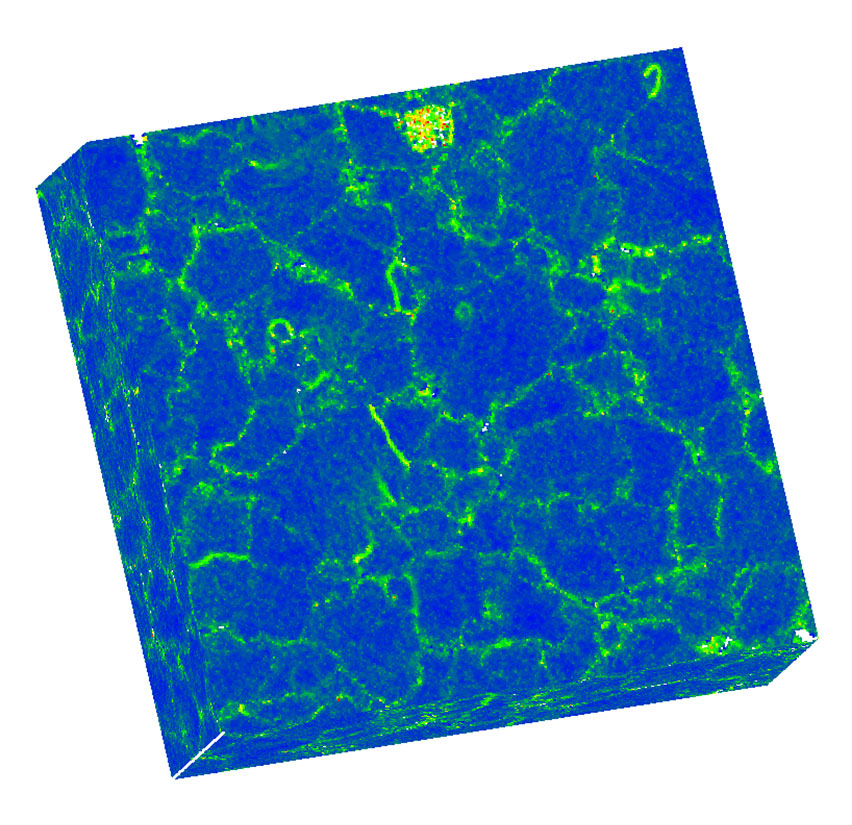 Figure 4. A KAM map in 3D revealing higher local misorientation near grain boundaries and within a precipitate in the microstructure.
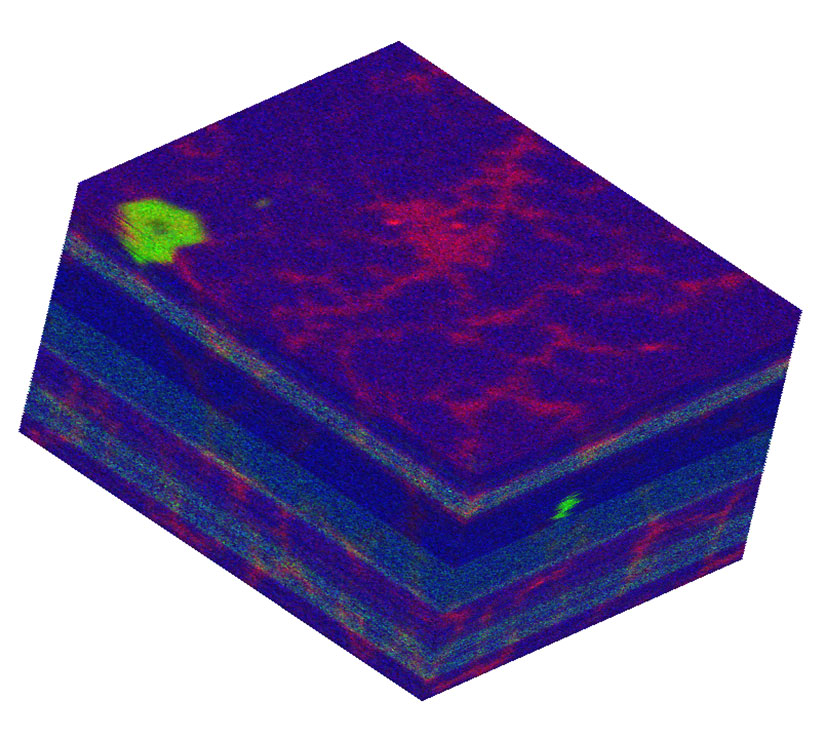 Figure 5. RGB map with niobium count intensity (red), titanium EDS count intensity (green), and nickel EDS count intensity (blue).
Conclusion
In summary, this application note shows how the Velocity EBSD detector and Octane Elite EDS detector can be used with modern FIB-SEM instruments and OIM Analysis to collect, analyze, and visualize microstructures in three dimensions. The Velocity Ultra provides the fastest EBSD collection speeds, which can significantly reduce the collection time of 3D datasets.
Acknowledgment
We would like to acknowledge and thank Michael Engstler and Christoph Pauly from the Universität des Saarlandes for providing the 3D EBSD-EDS dataset.