Dr. Chang Lu, Application Specialist, Gatan/EDAX
Having another chance to introduce some of the latest developments in electron backscatter diffraction (EBSD) technology on the EDAX blog is great. Today, I'd like to talk about the EDAX EBSD indexing algorithm. Through this article, readers will have a general understanding of how Kikuchi patterns are indexed in existing commercial software, what the technical limitations of the most commonly used Hough transform method are, and what other ways EDAX can offer to assist users in achieving higher indexing success rates (ISR) (dictionary indexing and spherical indexing method) for some of the most complex and challenging EBSD samples (even under adequate sample preparation).
To begin with, let's take a look at the EBSD results of a 7075 shot-peened aluminum sample. Figure 1a shows data extracted from Scientific Reports (Singh, S. et.al. High resolution low kV EBSD of heavily deformed and nanocrystalline aluminum by dictionary-based indexing. Scientific reports, (2018)). Obviously, this data did not turn out well, with a large number of areas filled with zero solutions (black) and only a few spots in the upper part of the sample that could be indexed.

Figure 1. a) EBSD results of a 7075 shot-peened aluminum sample indexed using the Hough transform method. b) The area of the shot-peened aluminum surface that is difficult to analyze (red is the recrystallized area; blue is the severe plastic deformation area).
A simple analysis shows that the poor ISR is due to the presence of two characteristic regions of the sample: the recrystallization area and the severe plastic deformation (SPD) area (Figure 1b). The recrystallization area is composed of many fine grains, and when Kikuchi patterns are collected on these tiny grains, Kikuchi pattern information from adjacent grains will inevitably be collected. Eventually, every pattern in this sample will have two or three sets of overlapping patterns. In this situation, the traditional Hough transform method is "confused" and gives a lot of zero solutions. The SPD area is more complex, and the essence of deformation is to apply stress on the material, in that there will be distortion and dislocation in the stressed lattice, which is reflected on the collected Kikuchi pattern, resulting in blurring and incomplete features. Therefore, Kikuchi patterns that contain twisted, deformed, and overlapping features are not easy to index in areas of SPD either.

Figure 2. A comparison of indexing results using the a and c) Hough transform method and b and d) dictionary indexing for the same set of EBSD data. The dictionary indexing shows better indexing results for both recrystallization and plastic deformation regions.
In this same article, Singh et al. used another indexing method, dictionary indexing, for this data set. Dictionary indexing results have significant advantages over the Hough transform method, as shown in Figure 2. In this case, the recrystallization area with a large number of fine grains was successfully indexed, and the smooth orientation transition within the severe plastic deformed area below was also realized. A dataset that seemed hopeless with the Hough method was rejuvenated under the processing of dictionary indexing.
How was all this achieved? Before introducing the dictionary and spherical indexing methods and their application cases, let's briefly review how the Hough transform method works in commercial EBSD systems.
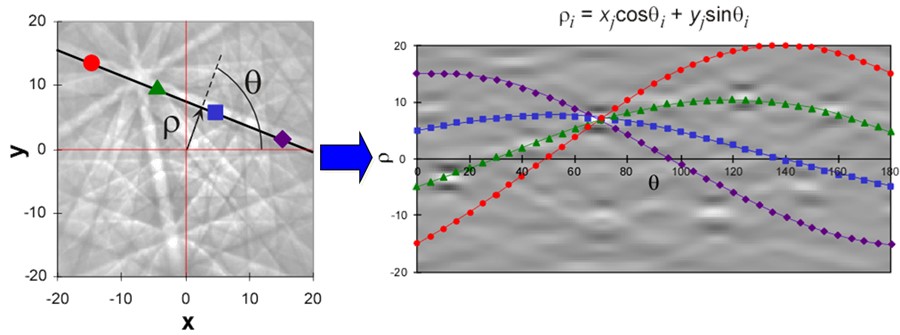
Figure 3. The principle of the Hough transform method for identifying Kikuchi bands: One Kikuchi band corresponds to one point in Hough space.
Figure 3 illustrates how the Hough method identifies bands in the Kikuchi pattern. We perform polar coordinate conversion of the signals in the acquired Kikuchi patterns. For example, for the four data points (red, green, blue, violet) on the same Kikuchi band, we take their Cartesian coordinates (x,y) from the Kikuchi pattern and then put them into the equation on the right top in Figure 3, so we get the four sinusoidal curves (x, y are constants, Pho and Theta are variables) in Hough space for these four data points. These four sinusoidal functions intersect only at one point in [0,180°]. This intersection represents this Kikuchi band in Hough space.
Many commercial software programs display a butterfly diagram like the one on the right of Figure 4, where each "bright spot" corresponds to a band identified in the EBSD pattern. Afterward, algorithms based on EDAX Triplet Indexing can extract the orientation and phase information corresponding to the EBSD pattern.
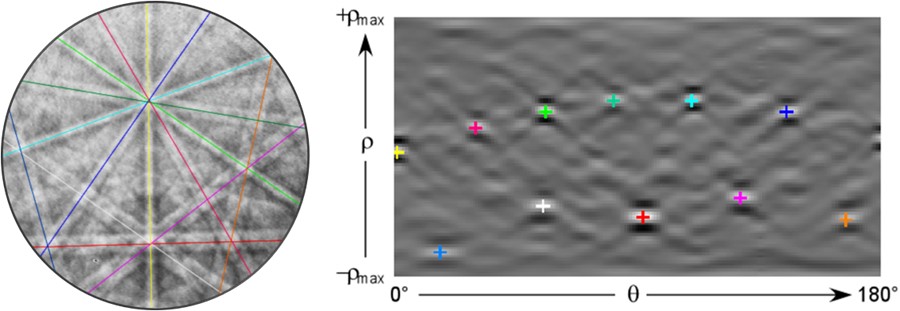
Figure 4. Butterfly points in Hough space, and the corresponding bands in an EBSD pattern.
When the sample quality is high and the EBSD patterns are clear, this Hough transform method can easily and quickly index an EBSD pattern. But what if the EBSD patterns are not good? For example, as mentioned earlier, samples that contain fine grains, stress, deformation, or the sample phase is a low-symmetry crystal type. The indexing ability of the Hough transform method is then limited.

Figure 5. The birth of theoretical EBSD patterns in dictionary indexing. A Monte Carlo simulation obtains a theoretical EBSD Kikuchi sphere for a specific phase lattice, a Lambert projection of an EBSD Kikuchi sphere to a two-dimensional plane, and specific orientation information can be extracted from this two-dimensional plane to obtain a specific theoretical pattern.
Dictionary indexing was created to solve the low indexing rate of these difficult samples. It relies on a forward-based physical model (DOI: https://doi.org/10.1017/S1431927621000738), which calculates the complete EBSD Kikuchi sphere information belonging to a sample phase based on the voltage and sample lattice information used. Then, considering the geometry of the EBSD detector, sample geometry, and microscope pole piece, and based on the user-defined misorientation accuracy, theoretically simulated EBSD patterns corresponding to many different orientations can be extracted from this sphere (Callahan, P. G., & De Graef, M. (2013). Microscopy and Microanalysis, 19(5), 1255-1265.). These generated EBSD patterns constitute a "dictionary." The subsequent indexing process is the familiar "dictionary lookup" (one-to-one comparison of experimentally collected EBSD patterns with the simulated EBSD patterns).
When comparing experimental patterns with theoretical patterns, the characteristic details in the patterns will be identified as multiple directionally different basis vectors (DOI: https://doi.org/10.1007/s40192-019-00137-4). We use the dot product (DP) to compare the characteristic details of specific regions in experimental and theoretical patterns (recall some of the high school mathematics, the modulus of basis vectors is 1, and the result of their dot product depends on the angle between the basis vectors,

Equation 1.
when the angle θ is 0, the dot product is maximum, which means a potential match for those vectors). When experimental patterns are compared with theoretical patterns one by one, the normalized dot product of the highest match is considered the "true solution." At this moment, the orientation from the theoretical pattern is the orientation to this experimental point under dictionary indexing. Thus, using dictionary indexing, we can index EBSD patterns with incomplete bands or blurry EBSD bands caused by poor sample quality. We can also distinguish phases of similar crystalline structures (such as beta-Ti and TiAl). After all, pseudo-cubic is not the real cubic.
In EDAX OIM Analysis™ 8.5, we commercialized dictionary indexing, which significantly contributed to the indexing for many difficult samples. I also wrote an experiment brief using dictionary indexing on one Ti sample. (Experiment Brief: Using dictionary indexing to achieve near 100% indexing rate on a highly deformed α-Ti microstructure). Figure 6 shows the microstructure of a highly deformed α-Ti alloy, which was difficult to characterize at first. With the same EBSD patterns, the Hough transform method and dictionary indexing gave "different" results. Previously, many transmission electron microscopy (TEM) studies have shown that deformation induces the appearance of nanocrystalline grains. Despite the numerous difficulties, dictionary indexing has brought higher ISR to this sample and showed better characterization of nanocrystalline grain structures (comparison of Figure 6f with Figure 6c).
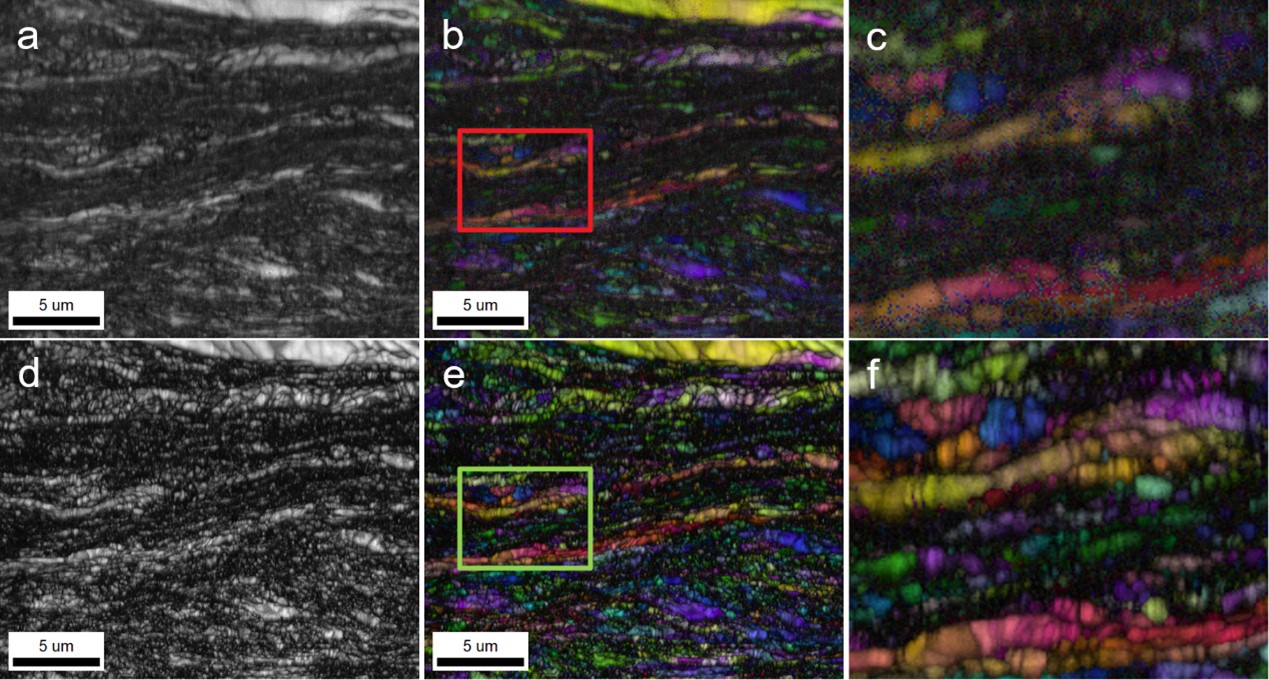
Figure 6. a) An IQ image using the Hough transform method. b) An IQ+IPF image using the Hough transform method. c) Enlarged details of the IQ+IPF image (highlighted in the red box) using the Hough transform method. d) A CI (DP) image using dictionary indexing. e) A CI (DP)+IPF image using dictionary indexing. f) Enlarged details of the CI (DP)+IPF image (highlighted in the green box) using dictionary indexing.
Although the results from dictionary indexing are excellent, the operation and computational requirements are not user-friendly, and the computation speed is slow (usually only 10 points per second (pps); it takes several hours or even days to calculate a sample). Therefore, in OIM Analysis 9, we introduced the spherical indexing method. The results from spherical indexing are similar to those from dictionary indexing. Still, the difference is that spherical indexing directly projects the collected experimental patterns onto the simulated Kikuchi sphere for pattern matching and comparison versus dictionary indexing, which needs to extract many EBSD patterns from the simulated Kikuchi sphere according to different orientations to construct a dictionary. Through spherical indexing, the computation speed is significantly improved. It can even achieve an indexing speed of over 10,000 pps (OIM Matrix™ web page). Faster indexing speed provides users with more convenience and possibilities from an application perspective.
For extremely low-quality EBSD patterns, we even support the combination of NPAR™ with spherical indexing to solve the most difficult EBSD samples (Figure 7). An almost meaningless dataset (Figure 7a with an ISR of 7.2%), achieved an ISR of 98.2% through EDAX NPAR and spherical indexing reindexing (Figure 7f).
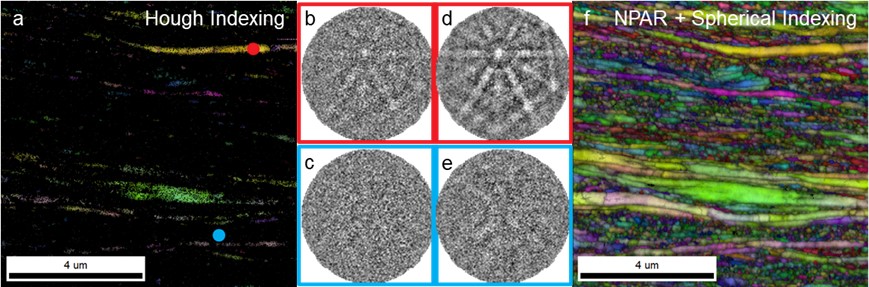
Figure 7. A highly deformed microstructure of α-Ti. a) Indexing result with the Hough transform method. Typical EBSD patterns of two regions, b) with slightly better quality and c) with poorer quality. (d – e) Through NPAR processing, the quality of the EBSD patterns in both regions has been improved. f) Indexing results with combined NPAR with spherical indexing.
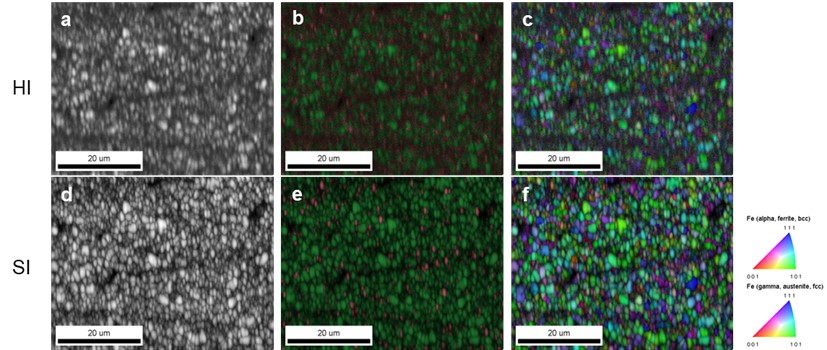
Figure 8. Comparison of Hough indexing (HI) and spherical indexing (SI) of a nanocrystalline dual-phase steel. a) and b) IQ maps, b) and e) phase maps, and c) and f) IPF maps.
Using spherical indexing, you can achieve excellent results with many samples that were previously considered difficult to handle, including nanocrystalline steel (Figure 8), severe deformation (Figures 6 – 7), and low symmetry. We can bring users more fulfilling (close to 100% indexing rate) results even for some samples with less satisfactory sample preparation.
If you have data collected on an EDAX EBSD device, please contact our Gatan applications team. We are very willing to use spherical indexing to improve your EBSD data quality, especially for samples that are troubling you. I believe EDAX's unique spherical indexing will help you to aim for higher-level journals and publications.