Matt Nowell, EBSD Product Manager, Gatan
Electron backscatter diffraction (EBSD) is a powerful analytical technique that scientists and engineers use to explore the inner workings of materials. By revealing the crystallographic orientation of materials at the microscopic level, EBSD enables us to see how metals and other materials are structured. This technique is especially valuable when studying deformed materials that have been bent, stretched, or compressed—because it helps us understand how they mechanically respond to stress and what makes them stronger or more ductile.
But the true power of EBSD lies in its precision. Accurately measuring the orientation of crystals within a material is essential for detecting subtle changes caused by deformation, such as the formation of low-angle grain boundaries or the movement of dislocations. High orientation precision allows researchers to uncover hidden details about how materials behave under pressure, leading to innovations in everything from aerospace components to everyday electronics.
Traditionally, Hough-based indexing provided orientation precision performance in the range of 0.1 – 0.5°. While this was sufficient for many applications, it limited the ability to resolve fine details—such as low-angle grain boundaries, dislocation structures, and small orientation gradients. To overcome these limitations, researchers turned to high angular resolution EBSD (HR-EBSD), a technique that compares EBSD patterns against a designated reference pattern. However, HR-EBSD comes with its own set of challenges. Achieving higher precision requires capturing higher pixel resolution patterns, which in turn slowed down data collection and demanded significant computational resources to achieve the desired performance.
EDAX® OIM Matrix™ provides an alternative route to improve orientation precision, achieving values below 0.01°. While spherical indexing is the most popular function in the OIM Matrix module, users can also take advantage of the powerful Refine mode. This feature uses a localized, real-space refinement approach—matching patterns simulated generated on the fly from a master pattern against an experimental EBSD pattern. The process begins with an initial orientation, which can come from either Hough-based or spherical indexing.
What sets this refinement apart is its efficiency: it works with smaller pattern resolutions (typically 120 x 120 pixels) and can achieve speeds up to 8,000 points per second. This means researchers can achieve exceptional precision without sacrificing speed, making high-quality EBSD analysis more accessible for routine and advanced materials characterization.
To showcase the capabilities of the OIM Matrix refinement function, EBSD data was collected from three different brass samples, each subjected to different levels of cold-rolling deformation: 4.5%, 10%, and 20%. Using the EDAX Velocity™ Super EBSD detector, data was gathered from a 903 x 685 μm area, with a 800 nm step size to ensure detailed sample coverage. The process was impressively efficient, achieving an acquisition speed of 3,000 points per second. EBSD patterns from each point were saved at a 120 x 120-pixel resolution for subsequent refinement and comparison.
Figure 1 shows inverse pole figure (IPF) orientation maps for each of the three samples, with colors representing the crystal direction aligned with the surface normal direction. These IPF maps, generated before any orientation refinement, offer a visual snapshot of how deformation affects the material’s internal structure. In the 4.5% reduction sample, most of the characterized grains are a solid color, reflecting relatively uniform orientation and minimal deformation. In contrast, the 10% and 20% reduction samples display more color variation within the grains, signaling increased plastic deformation introduced into the samples during the rolling process. These initial orientations were measured using Hough-based indexing. However, because the color scaling spans the full orientation space, the limitations of the Hough-based orientation precision cannot be easily seen in these maps.
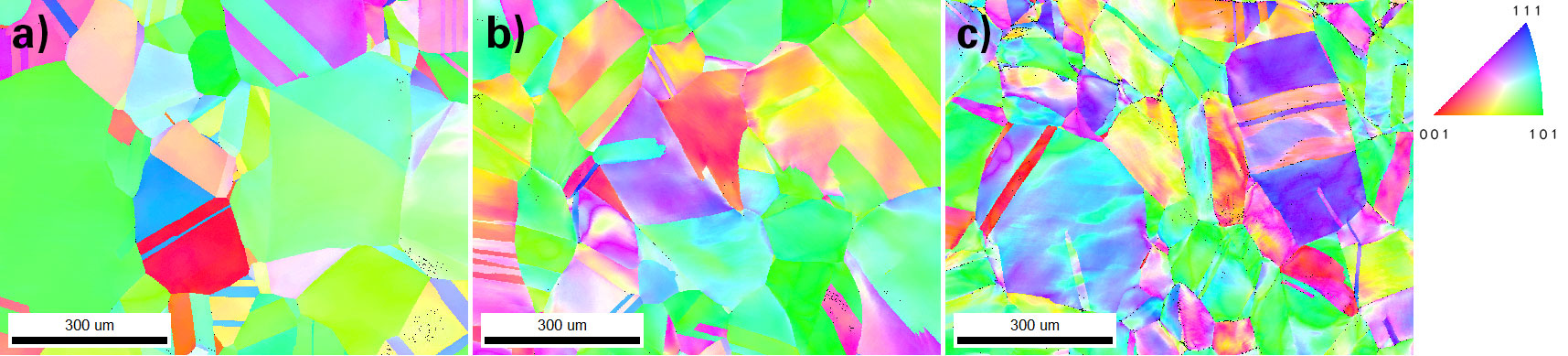
Figure 1. IPF orientation maps colored relative to the crystal direction aligned with the surface normal direction for the a) 4.5%, b) 10%, and c) 20% reduction samples.
Figure 2 shows the kernel average misorientation (KAM) maps from the three samples, still using the Hough-based orientation results. As the level of deformation increases—from 4.5% to 10% and 20% reduction—the KAM values rise accordingly, reflecting greater internal misorientation and plastic deformation within the material. Notably, the 4.5% reduction sample exhibits low levels of noise in the KAM values, especially within grain interiors, indicating a more uniform internal structure prior to significant deformation.
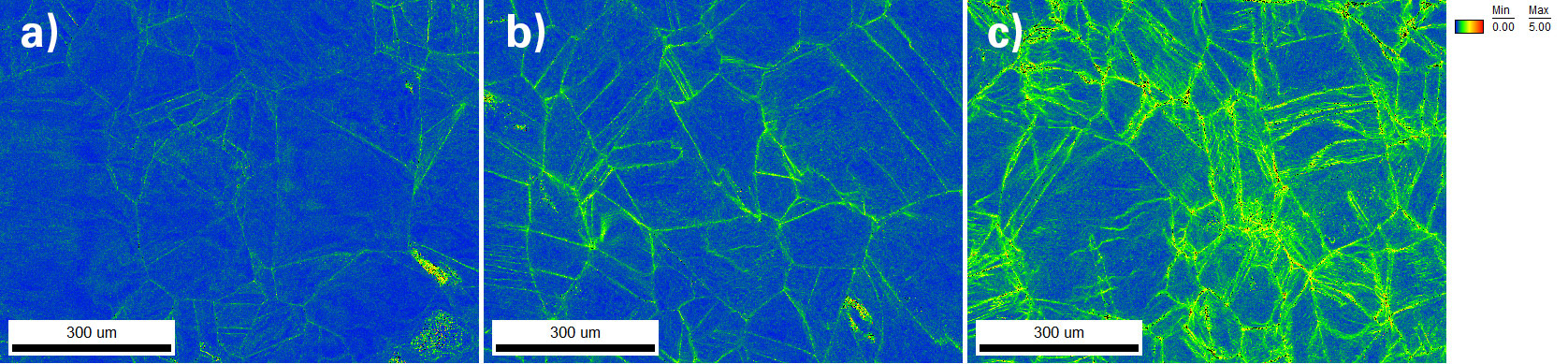
Figure 2. KAM maps from the a) 4.5%, b) 10%, and c) 20% reduction samples using the Hough-based orientation results.
For comparison, the OIM Matrix orientation refinement function was applied using the saved EBSD patterns from each of the three samples. Figure 3 shows the KAM maps after refinement. In the 4.5% reduction sample, the refined KAM maps reveal very little accumulated misorientations, with increases primarily near grain boundaries. For the 10% reduction sample, elevated KAM values are clearly visible along the primary slip planes for the material. These were confirmed with interactive analysis of the dataset.
Compared to the earlier maps (Figure 2), the refined KAM maps make it much easier to identify the slip traces and subtle structural changes, thanks to a significant reduction in noise after orientation refinement with OIM Matrix.
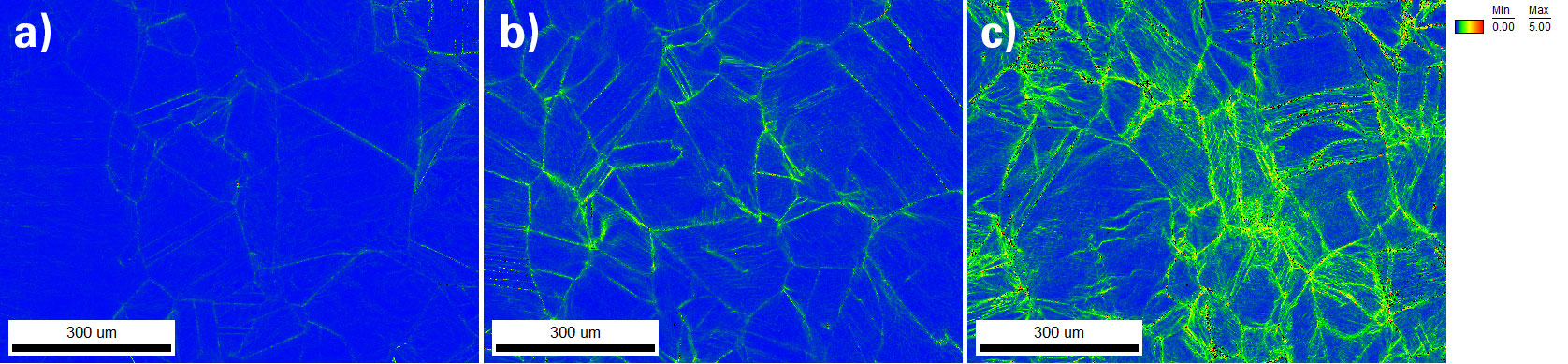
Figure 3. KAM maps from the a) 4.5%, b) 10%, and c) 20% reduction samples after the OIM Matrix orientation refinement function was applied using the saved EBSD patterns.
In conclusion, the orientation refinement functionality capabilities of OIM Matrix deliver a dramatic leap in EBSD measurement precision—an order of magnitude improvement in precision. This enhanced performance is important for detecting subtle lattice rotations and intragranular misorientations, making it an essential tool for studying plastic deformation, residual stress, and strain localization in advanced materials research. With OIM Matrix, scientists and engineers can unlock deeper insights into how materials behave under stress, paving the way for innovation in fields ranging from aerospace to electronics.