Dr. Sophie Yan, Applications Engineer, Gatan/EDAX
Recently, at an EBSD training school, a participant brought an NdFeB sample, claiming they hadn't obtained good results with it on their system, so they wanted to try it on mine. The sample was prepared with black resin. It wasn't an ideal sample, but it was acceptable (in fact, I later found that the surface flatness was quite good). I used hot glue to fix the sample to the holder and coated the surface with silver paste. After placing it in the chamber and inserting the EBSD detector, I found a clear pattern. I breathed a sigh of relief: this was much better than expected.
The results for this sample were quite good, with an indexing success rate of about 75%. After rescanning and using spherical indexing, the indexing success rate reached approximately 98%. According to the participant, EBSD results for this sample type are rarely seen, so they were eager to test the samples. Unfortunately, their previous tests did not yield usable results.
I discussed with the participants the reasons for the significant differences in results. Typically, they attach the samples using carbon tape, and surface treatment involves adding another strip. Although the tape claims to be conductive, its conductivity may be limited. My usual choice is to use metal clamps to prevent the sample from sliding during a 70-degree tilt or to use hot glue, which can secure the sample as much as possible. The non-conductive areas are coated with liquid silver or carbon paste.
Adjusting parameters such as voltage, beam current, and exposure time to obtain optimal results is necessary. However, these are often related to the material's properties, and a specific type of material typically has its own suitable range. If constrained by sample conditions, achieving the best voltage or beam current may be difficult, or the exposure time may be insufficient due to sample drift, which is quite unfortunate. Such situations should be avoided as much as possible.
Of course, the improvement in sample results due to spherical indexing should not be underestimated. The results from this experiment needed further processing, and I happened to have a similar sample, which showed a more pronounced contrast. The calibration success rate increased from 2.3% to 92% after spherical indexing, bringing new life to what I previously thought was useless data.
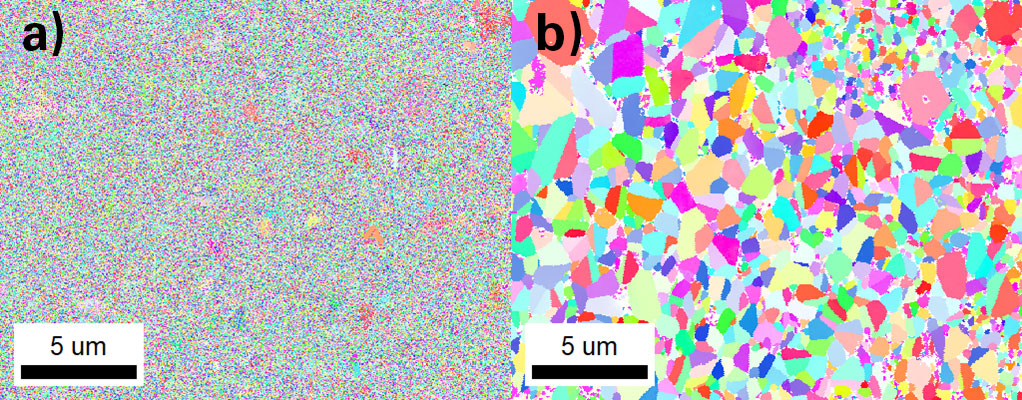
IPF map of a NdFeB sample with a) Hough indexing (indexing success rate 2.3%) and b) spherical indexing (indexing success rate 92%).
We have many techniques for challenging samples to overcome what previously seemed like impenetrable barriers. I hope my customers can also become proficient with using these techniques and achieve even better results.