M.Sc. Julia Mausz, Applications Specialist, EDAX, now part of Gatan
Have you ever thought it might really be brighter on the other side?
Just a couple of weeks ago, I shared my passion for spectroscopical techniques with my professor. I vividly remember the moment I first learned about energy dispersive spectroscopy (EDS) and wavelength dispersive spectroscopy (WDS) during my undergraduate program. The material science course covered a wide range of techniques, and part of the final exam involved understanding the fundamental differences in their measurement principles.
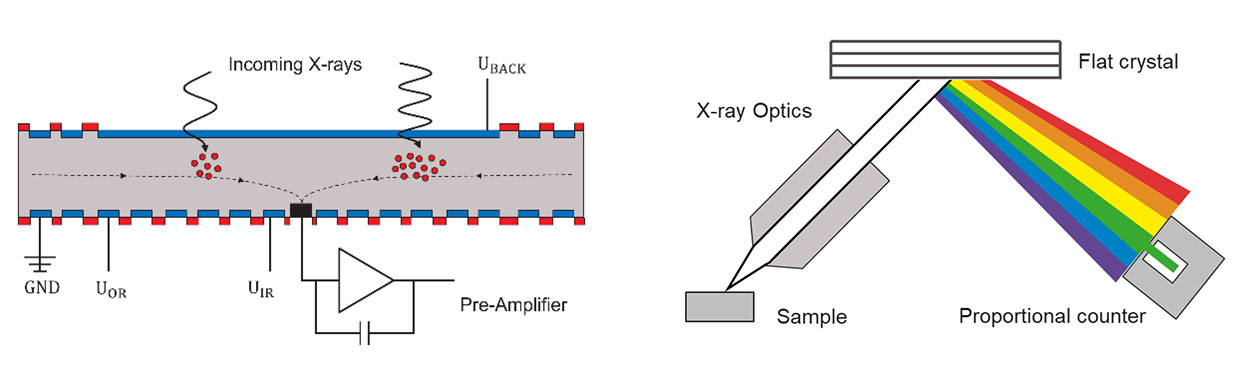
Figure 1. Illustration of the difference in detection principles between (left) EDS and (right) WDS.
The silicon drift detector (SDD) chip in the EDS detector absorbs the incoming x-rays, and a voltage signal increase can be measured proportional to these incoming energies. Here, a large range of energies can be collected “simultaneously”, giving an instant overview of the elements present and their composition.
On the other hand, during the WDS measurement, not all x-ray energies hit the detector at the same time. A crystal is used to disperse the incoming energies, and depending on the angle of the proportional counter, a thin energy band is measured at any given moment. To visualize a larger fraction of the spectrum, energies must be measured one after another by changing the angle of the detector and the crystal. With a much higher ultimate energy resolution, the WDS addresses peak overlaps and gives users the ability to detect trace elements down to much lower concentrations.
Often enough, theoretically knowing the method and the differences does not suffice to master the technique. Diving into a new field with little to no practical expertise can feel uncomfortable, overwhelming, or even intimidating. In this respect, WDS does resemble the dark side of the moon pretty well. For once, WDS does sound more mysterious and unknown than its brighter side (EDS).
However, the moon is only complete with both sides. They belong together and perfectly complement each other. Upon close examination, not only do the same physical principles apply, but this concept is also more familiar to us than we realize. Pink Floyd effectively illustrated the principle of energy dispersion with their iconic cover of their album “Dark Side of the Moon”. This may serve as an early reference to how easy and beautiful this technique can be.
While being frequently exposed to EDS measurement, I have only recently gotten the opportunity to use a WDS system. When Gatan released the EDAX Lambda WDS series, it all started with simple elemental scans to get a feeling for the technique and its workflows. The similarity between EDS and WDS did, however surprise me. The sample needs to be placed at the right height, the signal scales with the beam current, the measurement time must be clarified, and the elements of interest must be specified. The EDAX APEX™ software does support this process with automated functions and element suggestions to a large degree. The biggest change in my daily workflow was to open the P-10 gas supply.
Here are two measurement examples, where full elemental scans were carried out in the low-energy regime. B K and C K show fantastic signal-to-noise ratios and much improved energy resolution.
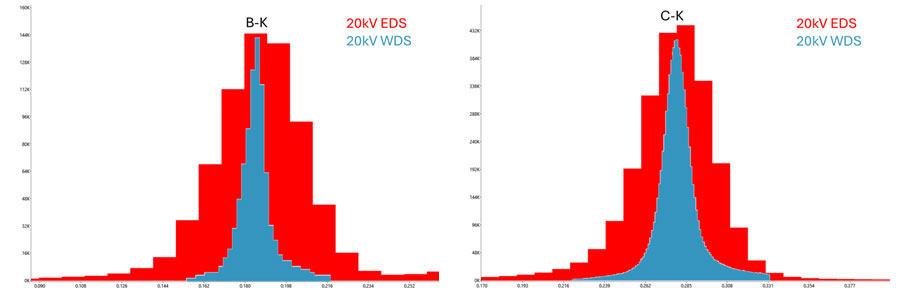
Figure 2. EDS and WDS measurements of (left) B K and (right) C K.
The shy flashlight I brought to the dark side of the moon quickly turned into a bold bonfire. One of the most exciting aspects of learning WDS was the ability to answer questions that EDS alone could not address. My vision extended further out from where I started and resolving peak overlaps and trace element analysis was soon a common technique for me. The major insight here is the location of the background. APEX chooses the background automatically, but for trace elements, small changes might be required.

Figure 3. EDS and WDS measurements of Fe Kß to highlight the presence of trace Co.
Interestingly, I was most reluctant to do WDS mappings. As a German, I would say I successfully misunderstood the time it takes to acquire the data. For WDS mappings, not every single element is mapped after each other, nor is the full peak scanned for each element of interest. The “easy” elements with no peak overlap and strong intensity are covered by the EDS. The “difficult” elements, which show a peak overlap in the EDS spectra or are below the detection limit of EDS, are addressed with the WDS. The combination of both techniques offers a huge advantage when it comes to acquisition time.
Now that I have made it to the other side of the moon, I can say that WDS is much less complicated than most people believe. Nowadays, almost all EDS measurements I perform are complemented by the parallel acquisition of WDS data, which reveals information that might otherwise be overlooked. This could include quick checks for possible missed elements in a peak overlap, common trace elements, or a few WDS mappings.
I am looking forward to all the interesting analyses that are about to come, and I would like to encourage all microanalysts to extend their knowledge into the unknown territory of WDS.