Dr. Stuart Wright, Senior Scientist, Gatan/EDAX
I recently did a webinar describing some of the tools in OIM Analysis™ for correlative microscopy. (https://www.youtube.com/watch?v=jFKauT1XccI). Correlative microscopy is an analytical technique where images are collected from the same area of a sample using different microscopy techniques. These images are then correlated to gain insight into a material’s microstructure and its properties. For example, correlating electron backscatter diffraction (EBSD) and energy dispersive x-ray spectroscopy (EDS) can reveal links between crystallography and chemical composition or improve the accuracy of our EBSD characterization of different phases present in the material [1].
In preparation for the webinar, I did a literature search for papers on correlative microscopy, where one of the imaging techniques used was EBSD. Seeing so many papers on the topic was nice, as the variety of techniques coupled with EBSD and the diversity of materials problems to which EBSD-based correlative microscopy was applied. I also had the good fortune of corresponding with several of the authors of those papers and learned a lot from those conversations.
Here is an excellent example [2] comparing results from high-resolution digital image correlation (HRDIC) and grain reference orientation deviation (GROD) maps for specific grains in a deformed microstructure. It is interesting to compare the slip lines seen in HRDIC images for different grains deforming in various modes with EBSD results.
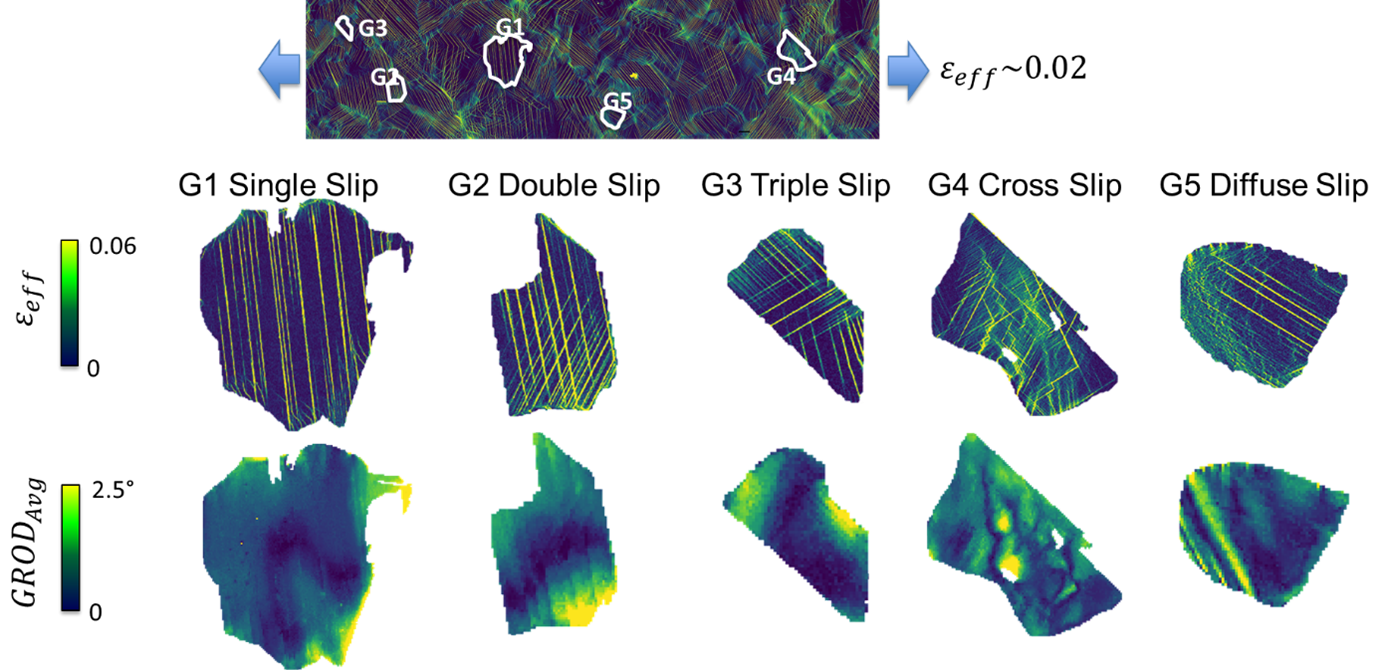
Figure 1. Correlation of HRDIC results with GROD maps from EBSD.
Figure 2 shows results from my earliest foray into correlative microscopy [3]. In this proof-of-concept example, we correlated EBSD results with EDS results to look for correlations between the chemical composition and the crystallography in a meteorite sample. (If my memory is correct, these images are from OIM Analysis 2, which ran on SunOS workstations; OIM Analysis 1 was exclusive to Silicon Graphics workstations.)
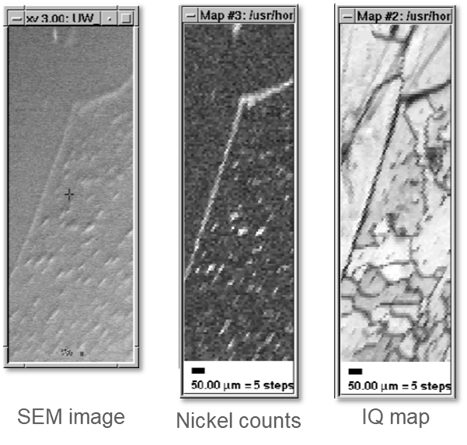
Figure 2. Correlation of EBSD and EDS on a meteorite.
Another early correlative microscopy study I’ve always liked is that done by Uwe König and co-workers [4] correlating crystallographic orientation with electrochemical properties. Some results from the work are shown in Figure 3.
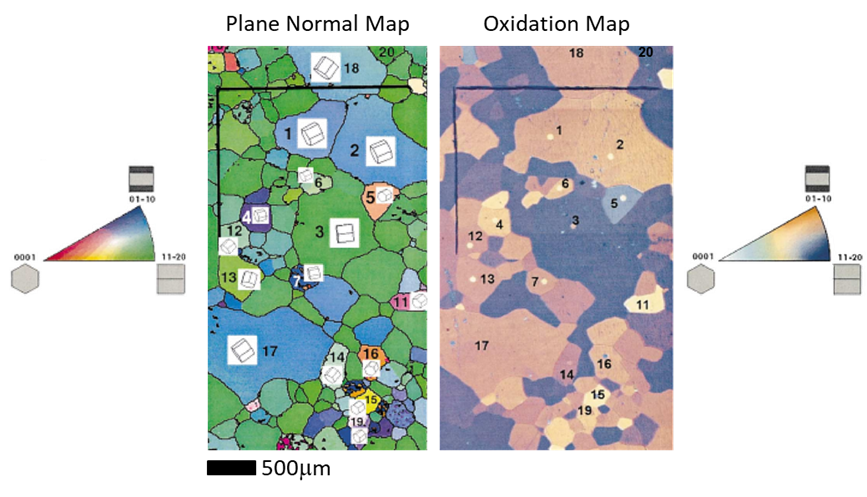
Figure 3. EBSD orientation map and oxidation map at a polarization of U = 15V. Courtesy of U. König, Heinrich-Heine-Universität Düsseldorf.
There has been a steady increase in EBSD-based correlative microscopy since those early studies. As I did my literature survey, I was impressed with how much can be learned when comparing images from many other techniques with EBSD, some of which I reported in the webinar [5-7].
At the same time I was preparing for the webinar, I was also reading a fascinating Pulitzer Prize-winning book by Ed Yong entitled “An Immense World” [8] with the tagline “How animal senses reveal the hidden world around us.” Learning how animals use various sensory systems to perceive their environments was fascinating. I also learned a new word, “umwelt,” which is the perceived environment of the animal. The term is German and often translated as “self-centered world” (Wikipedia). Depending on the creature and its sensory systems, the umwelt may be very small or huge. While we have other senses, humans strongly prefer our well-developed optical sensory system. It is interesting to consider how animals form sensory “images” of their umwelt using senses besides optical. Here are a few examples:
- Bats' echolocation skills are already well-known.
- Sharks and platypuses sense faint electric fields.
- Robins and sea turtles can sense magnetic fields.
- Seals can trace the trail of swimming fish with their whiskers, e.g., a mechanical sensory system.
- Pollinating insects and rattlesnakes can see colors in the infrared spectrum.
- Dogs can sense a 3D spatial umwelt and a temporal one via their olfactory sensory systems.
Like correlative microscopy, many animals use multiple sensory techniques to gain a more complete perception of the world around them and help them find things to eat or avoid being eaten. It is also made me aware of how much our language is molded by our reliance on our optical system – insight, worldview, sensory image, …
I hate to get too serious in my blogs. Still, I’ve spent a lot of time contemplating these ideas since the webinar, and it seems that these ideas have an extensive and important application beyond EBSD, microscopy, or even a predator locating prey. It seems that correlative microscopy is almost a metaphor for our need to be more intentional in diversifying our worldview instead of falling into the echo chambers of social media. This certainly is not a new concept but simply a new spin on one that needs reinforcing in the fractured world we find ourselves in. For example, consider the Indian parable of the blind men and the elephant or the idiom “Before you judge a man, walk a mile in his shoes.” More apropos to this blog is the counsel my parents often gave me after a rash reaction to someone I felt had wronged me to “try and see the world through their eyes” – “their” being one of my brothers or someone I had a conflict with at school, or an “unfair” teacher, or …
In the webinar, I referred to a paper in which several research teams used HRDIC and EBSD cooperatively [9] to gain insights into an individual grain’s umwelt during mechanical deformation. I suspect that if we could cooperatively correlate our worldviews, we could improve our own umwelts and maybe even a little beyond.
References
- Nowell, M.M. and Wright, S.I., 2004. Phase differentiation via combined EBSD and XEDS. Journal of microscopy, 213, 296-305.
- Harte, A., Atkinson, M., Preuss, M. and Da Fonseca, J.Q., 2020. A statistical study of the relationship between plastic strain and lattice misorientation on the surface of a deformed Ni-based superalloy. Acta Materialia, 195, 555-570.
- Wright, S.I. and Field, D.P., 1997. Analysis of Multiphase Materials Using Electron Backscatter Diffraction. Microscopy and Microanalysis, 3(S2), 561-562.
- König, U. and Davepon, B., 2001. Microstructure of polycrystalline Ti and its microelectrochemical properties by means of electron-backscattering diffraction (EBSD). Electrochimica Acta, 47, 149-160.
- Wille, G., Lerouge, C. and Schmidt, U., 2018. A multimodal microcharacterisation of trace‐element zonation and crystallographic orientation in natural cassiterite by combining cathodoluminescence, EBSD, EPMA and contribution of confocal Raman‐in‐SEM imaging. Journal of Microscopy, 270, 309-317.
- Naik, C.A., Kumar, B.S., Harita, S., Roshan, S., Janakiram, S., Phani, P.S. and Gautam, J.P., 2024. Assessment of structure-property relationships at the micrometer length scale in dual phase steels by electron microscopy and nanoindentation. Materials Today Communications, 38, 107696.
- Kavalakkatt, J., Abou-Ras, D., Haarstrich, J., Ronning, C., Nichterwitz, M., Caballero, R., Rissom, T., Unold, T., Scheer, R. and Schock, H.W., 2014. Electron-beam-induced current at absorber back surfaces of Cu (In, Ga) Se2 thin-film solar cells. Journal of Applied Physics, 115, 014504.
- Yong, E., 2023. An Immense World, Random House
- Sperry, R., Han, S., Chen, Z., Daly, S.H., Crimp, M.A. and Fullwood, D.T., 2021. Comparison of EBSD, DIC, AFM, and ECCI for active slip system identification in deformed Ti-7Al. Materials Characterization, 173, 110941.