M.Sc. Julia Mausz, Applications Specialist, Gatan
Lithium manganese iron phosphate (LMFP), LiMn1-x Fex PO4, is gaining attention as a promising cathode material for lithium-ion batteries. One innovative strategy to boost battery performance is to incorporate fluorine into the cathode structure. By engineering fluorine-rich interfaces, researchers can significantly enhance the electrochemical properties of LMFP, paving the way for longer-lasting and more efficient batteries.
But how do we know where the fluorine ends up? Understanding the distribution of fluorine within the cathode is crucial for guiding material development and optimizing battery performance. This is where advanced characterization techniques come into play.
A common method for visualizing elemental distributions is x-ray energy dispersive spectroscopy (EDS). EDS maps are displayed using the raw integrated intensity of x-rays measured within a defined energy range for a given element. These maps are also called region of interest (ROI) mapping.
 Figure 1. Elemental distribution maps on LMFP showing a) Fe-L, b) Mn-L, and c) F-K using raw intensity.
While elemental maps generated by EDS can be pretty, it's important to dig deeper than appearances. The colorful patterns we see may not always represent the true distribution of elements in a sample. These maps can be affected by background signals, such as Bremsstrahlung radiation, which aren't actually linked to the element you're trying to detect. Additionally, when elements in the sample have x-ray peaks that are close together, their signals can overlap, making it difficult to distinguish one element from another. As a result, the "pretty" maps might sometimes be misleading.
For researchers and engineers, understanding these limitations is crucial. By questioning and verifying the validity of elemental maps, we can ensure that our interpretations are accurate—and that our materials development is headed in the right direction.
In this LMFP sample, the energy of the Mn-L, F-K, and Fe-L lines overlap heavily in the EDS spectrum, as highlighted in Figure 2a. This overlap can make it difficult to distinguish where each element is truly located.
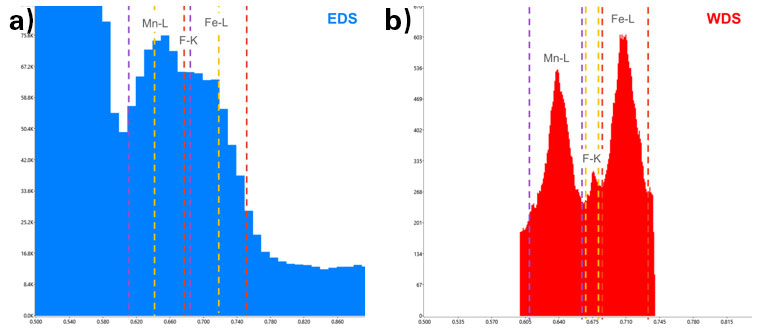 Figure 2. Comparison between a) EDS and b) WDS illustrating the ROI of given elements and the difference in resolving power; the ROIs are drawn with colors matching the elemental maps in Figure 1.
Fortunately, advanced EDS systems provide tools to help untangle these signals. For example, NET maps show the net intensity of each element by correcting for background noise and mathematically separating overlapping peaks at every pixel. For even deeper insight, a ZAF maps can be applied to each pixel to quantify the elemental concentrations (wt. % or at. %) and account for both peak overlap and sample topography.
So, can we use NET or ZAF maps to reveal the true fluorine distribution? It’s a critical question, especially when there are three heavily overlapped peaks and limited statistics? While EDS ROI maps can look impressive, their reliability is sometimes questionable.
To establish the “ground truth” for the “pretty” F-K EDS ROI maps, we need a technique with higher energy resolution: wavelength dispersive spectroscopy (WDS). WDS can clearly separate the signals from Mn, F, and Fe, making it possible to accurately measure fluorine’s presence. As show in Figure 2, the WDS spectrum reveals that the F-K contribution to the overall signal is extremely low. However, when we look at the WDS-generated maps (Figures 3c and 3f), we see a higher concentration of fluorine at the surface of the cathode layer and extends ~1 µm into the layer, with a lower intensity observed in the cathode layer’s interior. Some subtle variations in the F distribution are also observed.
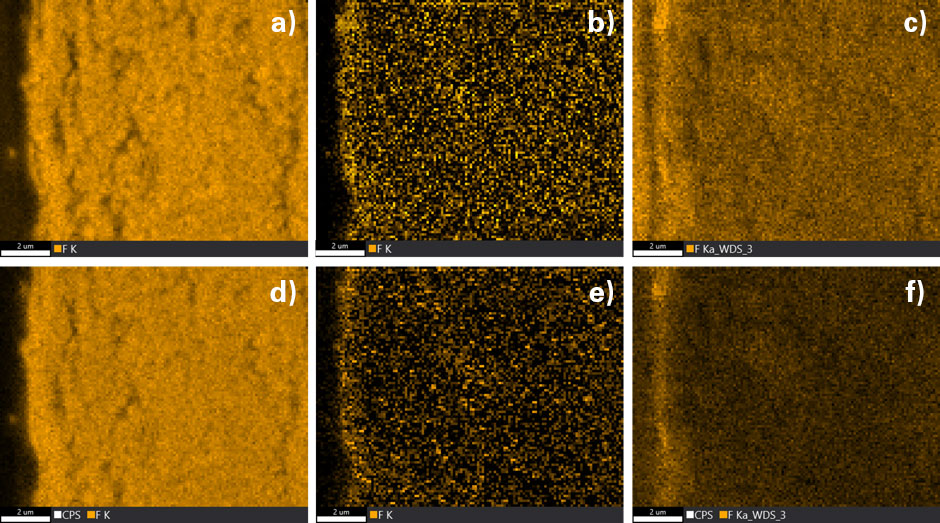 Figure 3. Comparison between fluorine distribution maps a and d) EDS ROI counts, b and e) EDS deconvoluted, and c and f) WDS maps. The bottom maps are normalized by the total x-ray signal to mitigate the effects of topography on x-ray emission from the sample.
The deconvoluted EDS NET maps (Figure 3b and 3e) reveal a similar distribution of fluorine as in the WDS maps. However, the EDS ma NET maps come with up to six times higher relative standard deviation (see Table 1), making them significantly more difficult to interpret. In fact, without the “ground truth” provided by WDS, it would be extremely difficult, if not impossible, to draw a conclusion from the EDS data alone.
| |
EDS (NET) |
WDS |
| |
Low F |
High F |
Low F |
High F |
| Relative Standard Deviation |
1.139 |
0.487 |
0.192 |
0.225 |
Table 1. Comparison of the relative standard deviation in the EDS and WDS maps, collected under identical conditions.
Looking into the EDS data in detail, the reason is clear. In high quality spectra (e.g., summed spectra from many pixels, Figure 4a and 4b), the difference in peak shape between fluorine-rich and fluorine-free areas is pronounced. But in spectra with poorer statistics, the difference is barely recognizable (Figures 4c and 4d). The increased uncertainty at individual points leads to more error in the NET maps.
 Figure 4. Comparing EDS summation spectra with per point statistic in regions of low and high fluorine concentration using the WDS maps as a guidance.
The takeaway: don’t trust raw maps blindly. Always question whether peak overlaps exist, understand the limitations of deconvolution, and consider statistical robustness before drawing conclusions. Contrary to the common misconception that WDS maps take too long to be useful, int this study, WDS and EDS maps were captured simultaneously. When you need a high degree of confidence in your results, WDS remains the best option.