Matt Nowell, EBSD Product Manager, Gatan
EDAX OIM Matrix™ is a module within EDAX OIM Analysis™ that is often used for improving the electron backscatter diffraction (EBSD) pattern indexing performance on challenging materials using the spherical indexing functionality. Orientation precision measurements can also be improved using the Orientation Refinement functionality. In both cases, OIM Matrix uses master patterns, which are representations of the diffraction intensities in all orientations that are traditionally generated using dynamical diffraction simulations. Depending on the complexity of the unit cell of the material being analyzed, these master patterns can take minutes to hours to calculate.
A new method has been implemented in OIM Analysis 9.1 which allows for the creation of master patterns using saved experimental patterns. These master patterns capture the true EBSD pattern intensities and details and can do so much faster than dynamical diffraction modeling.
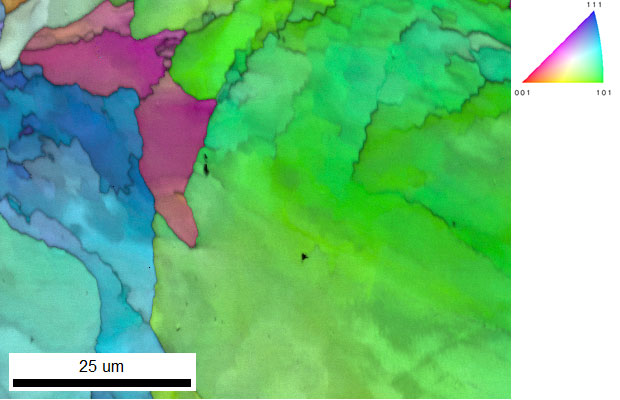
Figure 1. A combined IQ and IPF orientation map, colored relative to the surface normal direction.
To demonstrate the use of an experimental master pattern for orientation refinement, EBSD data was collected from an additively manufactured 316-L stainless steel sample using an EDAX Velocity™ EBSD detector at 120 x 120-pixel resolution. EBSD patterns were saved during the acquisition.
Figure 1 shows a combined image quality (IQ) and inverse pole figure (IPF) orientation map, colored relative to the surface normal direction. This map was collected from a few grains to observe the detail within the grain structure. The slight changes in color indicate smaller orientation changes within the principal grains.
Figure 2 shows the kernel average misorientation (KAM) map for this same region of interest, with point-to-point misorientations between 5 – 15° colored with a thin black line and misorientations greater than 15° colored with a thicker black line to show to overall grain boundary structure. Within the grains, the KAM map shows informational structure along with orientation measurement noise.
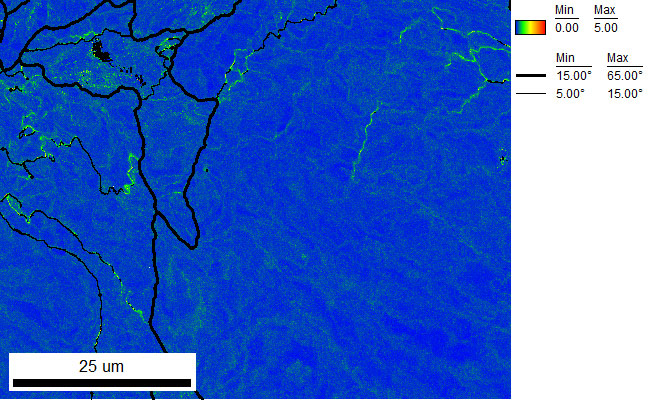
Figure 2. The KAM map for the same region of interest as Figure 1.
Figure 3a shows a representative EBSD pattern saved during the mapping acquisition. Figure 3b shows the corresponding simulated EBSD pattern derived from a dynamical diffraction-based master pattern. In this example, the phase of interest is face centered cubic (FCC) austenite. The dynamic diffraction master pattern for this relatively simple unit cell (with only Fe occupying the lattice sites) was calculated in five minutes. Figure 3c shows the corresponding EBSD pattern derived from an experimental master pattern.
For the experimental master pattern creation, saved EBSD patterns representing the unique portion of orientation space are identified in the saved pattern file, and used to populate the master pattern sphere. Calculating the master pattern with this approach took only 30 s and captures the truest representation of the diffraction projections and intensities.
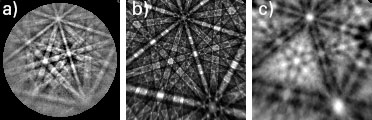
Figure 3. a) A representative EBSD pattern saved during mapping acquisition. b) The corresponding simulated EBSD pattern derived from a dynamical diffraction-based master pattern. c) The corresponding EBSD pattern derived from an experimental master pattern.
The experimental master pattern was used for orientation refinement, which optimizes the orientation solution by accurately fitting the collected EBSD pattern to the master pattern. Figure 4 shows the KAM map after refinement. Very little subgrain structure is visible with this level of orientation precision. This data was collected with a 40 nm step size, and the KAM map shows little local change in orientation on this scale.
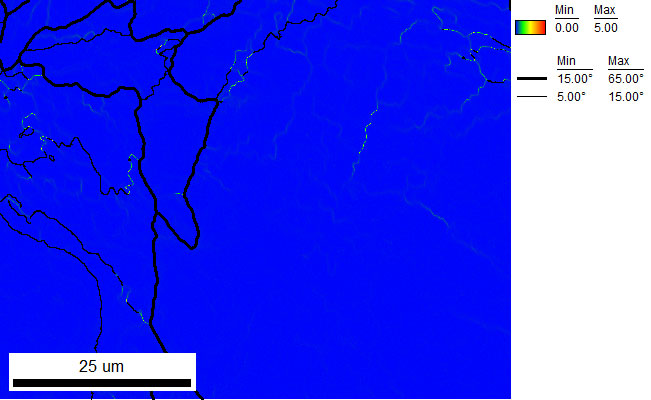
Figure 4. The KAM map after refinement.
Figure 5 shows a local orientation spread (LOS) map to better visualize the microstructure within these grains. In this example, an 8th nearest neighbor kernel was used to calculate the local spread in orientation. This LOS map now shows the location of the subgrain boundaries and structure that developed during the additive manufacturing process.
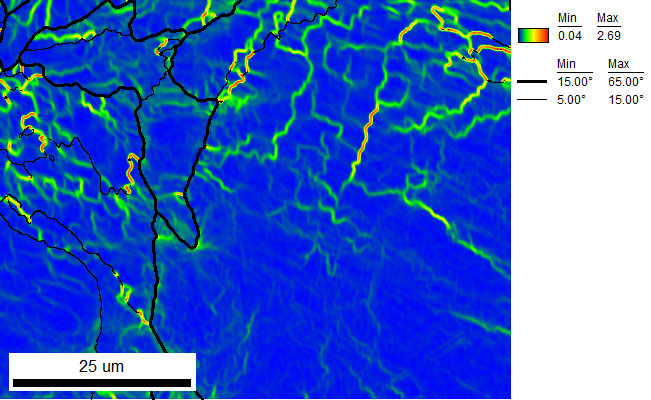
Figure 5. LOS map showing the location of the subgrain boundaries and structure that developed during the additive manufacturing process using the 8th nearest neighbor kernel to calculate the local spread in orientation.
In summary, the ability to create experimental patterns allows users to quickly access the power of spherical indexing to improve the orientation precision measurements. This performance allows a better understanding of the subgrain microstructure that develops during the additive manufacturing process which in turn affects the resulting material properties and performance of the final build.